

In Part 1 of this series on CoreWeave, we introduced their foundation of debt that puts shareholders at serious risk. We also put a target share price of $0 on the stock with a clear “SELL” rating. Our target is the base case we have on the company’s valuation and we make no claims on the timing of when it is realized (though it may come sooner than shareholders think).
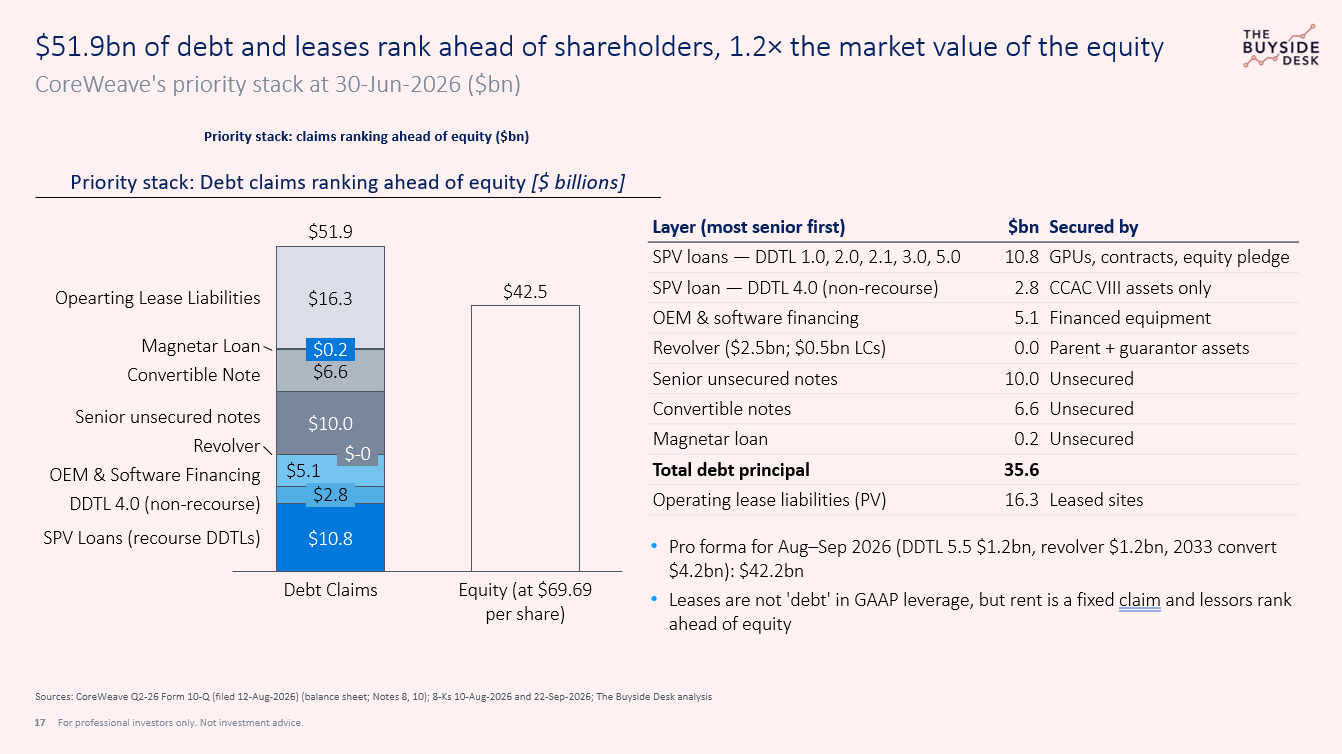
There is $52 billion of claims that rank ahead of shareholders in the capital structure. This is comprised of $35.6 billion of debt and $16.3 billion of lease liabilities. Together this represents 1.2x that market cap of the company (share price $69.69 at time of analysis). Moreover, the asset-level debt is not ring-fenced. CRWV guarantees $10.8 billion of loans held in its SPVs. A default at one SPV can trigger CRWV’s bonds.
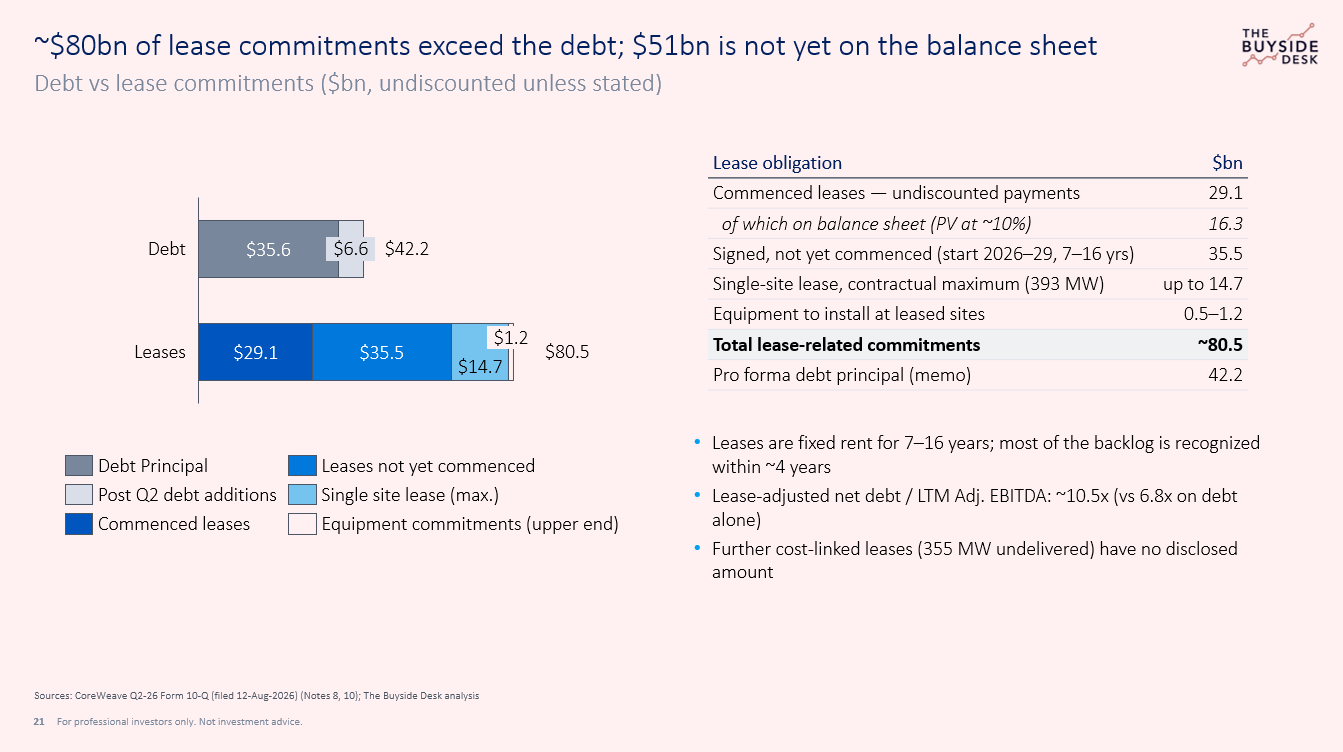
When taking leases into account, there are ~$80 billion of lease commitments, of which $51 billion is not on CRWV’s balance sheet. If you adjust for this, (“lease adjusted”) leverage is a whopping 10.5x. This is why investors need to look deeper into the liabilities structure of the company. Their astonishing use of debt to fuel their equally astonishing growth puts shareholder capital at risk. As we said in Part 1, the company has value…it just won’t accrue to shareholders (who are likely to be wiped out).
But first a short debt primer for equity investors
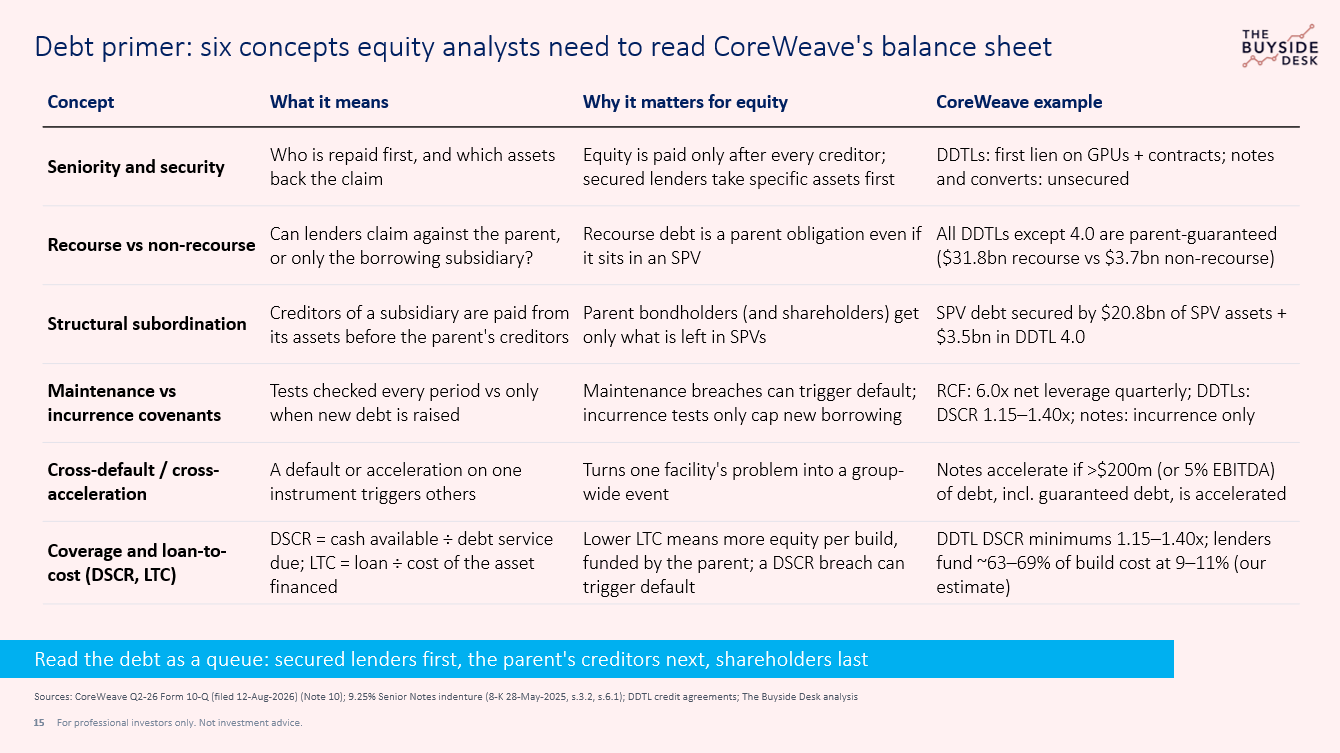
Most equity investors read a balance sheet for the size of the debt. With CoreWeave, the order matters as much as the size. Think of every claim on the company as a queue: secured lenders first, the parent’s other creditors next, shareholders last. Six concepts tell you where each claim stands:
• Seniority and security: who is repaid first, and which assets back each claim. CoreWeave’s DDTLs have a first lien on GPUs and contracts; its bonds and convertibles are unsecured.
• Recourse vs non-recourse: can lenders claim against the parent, or only against the borrowing subsidiary? Recourse debt is a parent obligation even if it sits in an SPV.
• Structural subordination: a subsidiary’s creditors are paid from its assets before the parent’s creditors. Parent bondholders, and shareholders, get only what is left in the SPVs.
• Maintenance vs incurrence covenants: tests checked every quarter, versus tests checked only when new debt is raised. A maintenance breach can trigger a default.
• Cross-default / cross-acceleration: a default on one instrument triggers others, turning one facility’s problem into a group event.
• Coverage and loan-to-cost: DSCR is cash available divided by debt service due; loan-to-cost (LTC) is the loan divided by the cost of the asset financed. A lower LTC means more equity per build, funded by the parent.
Note: Our full Analyst Materials includes a 62-page deep dive into CRWV’s debt and a much more detailed debt primer. Please subscribe, it will be published shortly.
Why leverage magnifies everything
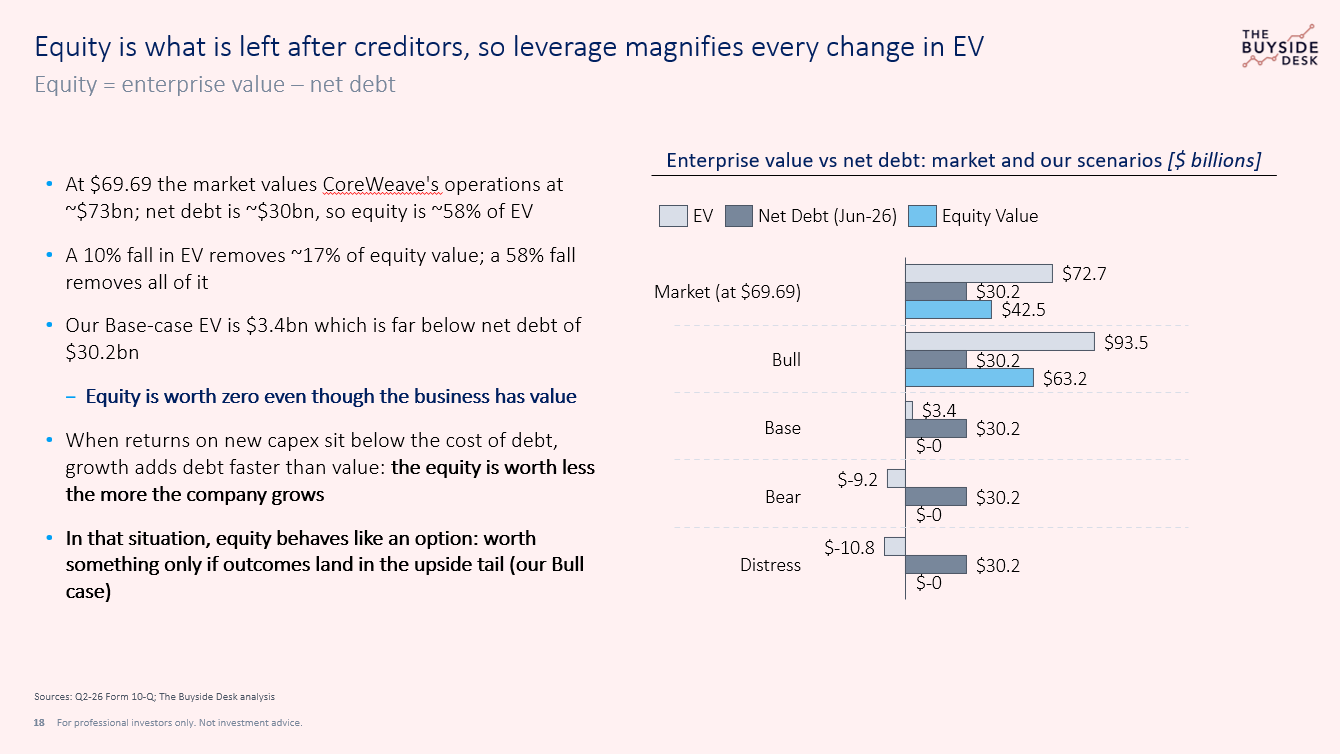
Equity is what is left after creditors. At $69.69, the market values CoreWeave’s operations at about $73bn. Net debt is about $30bn, so equity is about 58% of that value.
That ratio does the damage. A 10% fall in enterprise value removes about 17% of the equity. A 58% fall removes all of it. Our base-case enterprise value is $3.4bn, far below net debt of $30.2bn: the business has value, but the equity is worth zero.
There is a second, less obvious effect. When the return on new capex is below the cost of the money funding it, growth adds debt faster than it adds value. The equity is then worth less the more the company grows. Part 4 shows that this is CoreWeave’s position at today’s margins.
That is $51.9bn ahead of shareholders, against an equity market value of $42.5bn. Pro forma for the deals since June (a further DDTL draw, a revolver draw and a new 2033 convertible), debt alone is $42.2bn.
Leases are not counted as “debt” in most leverage ratios. But rent is a fixed claim, and landlords rank ahead of equity.
The “asset-level” loans are really the parent’s
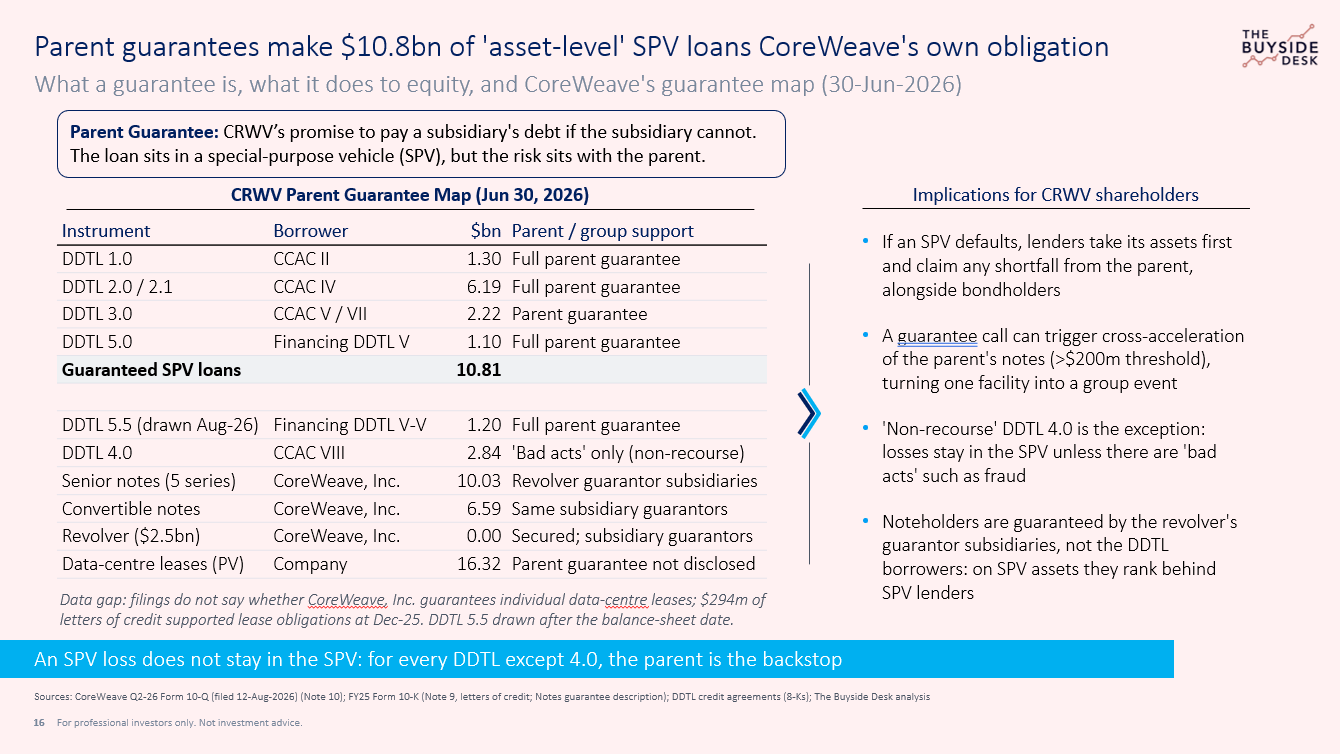
CoreWeave describes its DDTLs as asset-level financing, which sounds as if the risk stays inside each SPV. Mostly, it doesn’t. A parent guarantee is CoreWeave, Inc.’s promise to pay a subsidiary’s debt if the subsidiary cannot. The loan sits in the SPV; the risk sits with the parent.
Four things follow for shareholders:
• If an SPV defaults, its lenders take the SPV’s assets first and claim any shortfall from the parent, alongside the bondholders.
• A guarantee call can trigger cross-acceleration of the parent’s bonds (the threshold is $200m), turning one facility into a group-wide event.
• DDTL 4.0 is the exception. It is non-recourse, so losses stay in the SPV unless there are “bad acts” such as fraud.
• The bonds are guaranteed by the revolver’s guarantor subsidiaries, not by the DDTL borrowers. On SPV assets, bondholders rank behind the SPV lenders.
One gap in the disclosures: the filings do not say whether CoreWeave, Inc. guarantees individual data-centre leases. $294m of letters of credit supported lease obligations at the end of 2025. DDTL 5.5 (a further $1.2bn drawn in August, also fully guaranteed) came after the balance-sheet date.
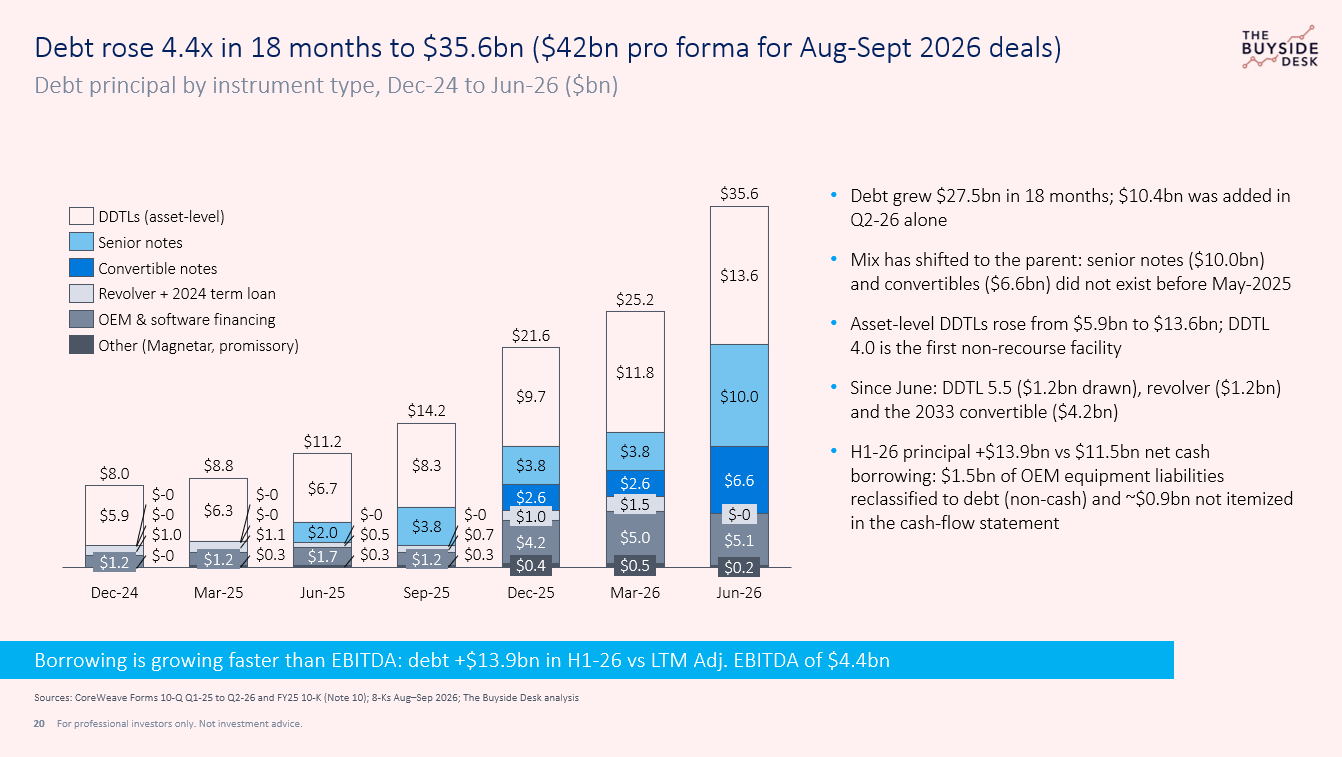
Debt has increased 4.4x in 18 months
Debt principal grew from $8.0bn at the end of 2024 to $35.6bn in June 2026, $27.5bn in 18 months. $10.4bn was added in Q2-26 alone. In the first half of 2026, debt rose $13.9bn while LTM adjusted EBITDA was $4.4bn: borrowing is growing much faster than earnings.
The mix has also moved to the parent. Senior notes ($10.0bn) and convertibles ($6.6bn) did not exist before May 2025. Asset-level DDTLs rose from $5.9bn to $13.6bn. Since June, CoreWeave has drawn $1.2bn on DDTL 5.5, $1.2bn on its revolver, and issued a $4.2bn 2033 convertible.
Leases are bigger than the debt
“In addition to our substantial debt, we lease all of our data centers and certain equipment under lease agreements…” CoreWeave Q2-26 Form 10-Q
The balance sheet shows $16.3bn of lease liabilities. That is the present value of leases that have already started. The full commitment is far larger. About $51bn of that is not yet on the balance sheet. Including leases, net debt is about 10.5x LTM adjusted EBITDA, against 6.8x on debt alone. And leases are fixed rent for 7–16 years, while most of the backlog is recognized within about four.
Interest is 5x operating profit
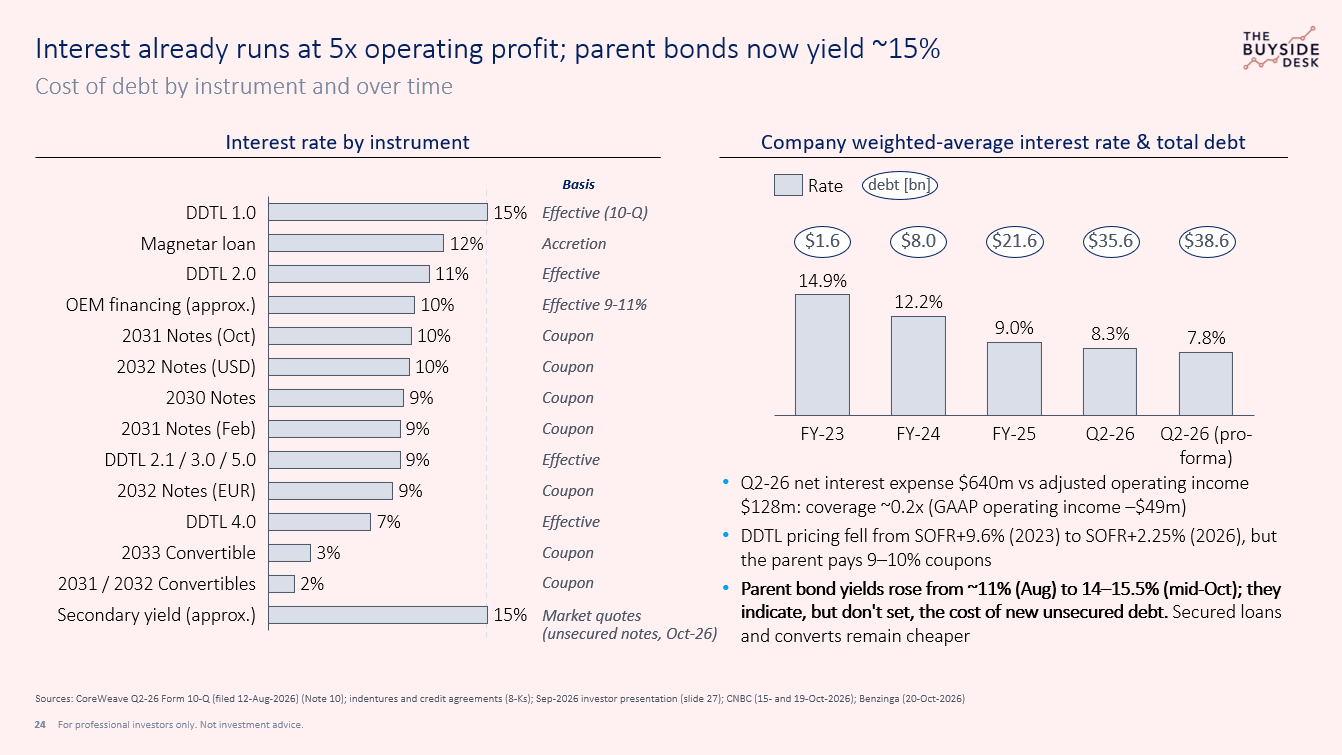
In Q2-26, net interest expense was $640m. Adjusted operating income was $128m, so interest coverage was about 0.2x. On a GAAP basis, operating income was negative (–$49m). The cost of the asset-level loans has fallen sharply, from SOFR+9.6% on the first facility in 2023 to SOFR+2.25% on the latest, as customer credit quality improved. The parent, though, pays 9–10% coupons on its bonds. Third-party reports put those bonds’ yields at about 11% in August and 14–15.5% by mid-October. Yields indicate, but don’t set, what new unsecured debt would cost; secured loans and convertibles remain cheaper.
The maturity profile adds a timing problem. $10.6bn of debt falls due by the end of 2027, mostly self-amortizing DDTL and vendor-finance instalments paid from contract cash. Then $16.6bn of parent bonds and convertibles fall due in 2030–32, just as today's contracts roll off (more on this coming in Part 3).
Ring-fencing is weak
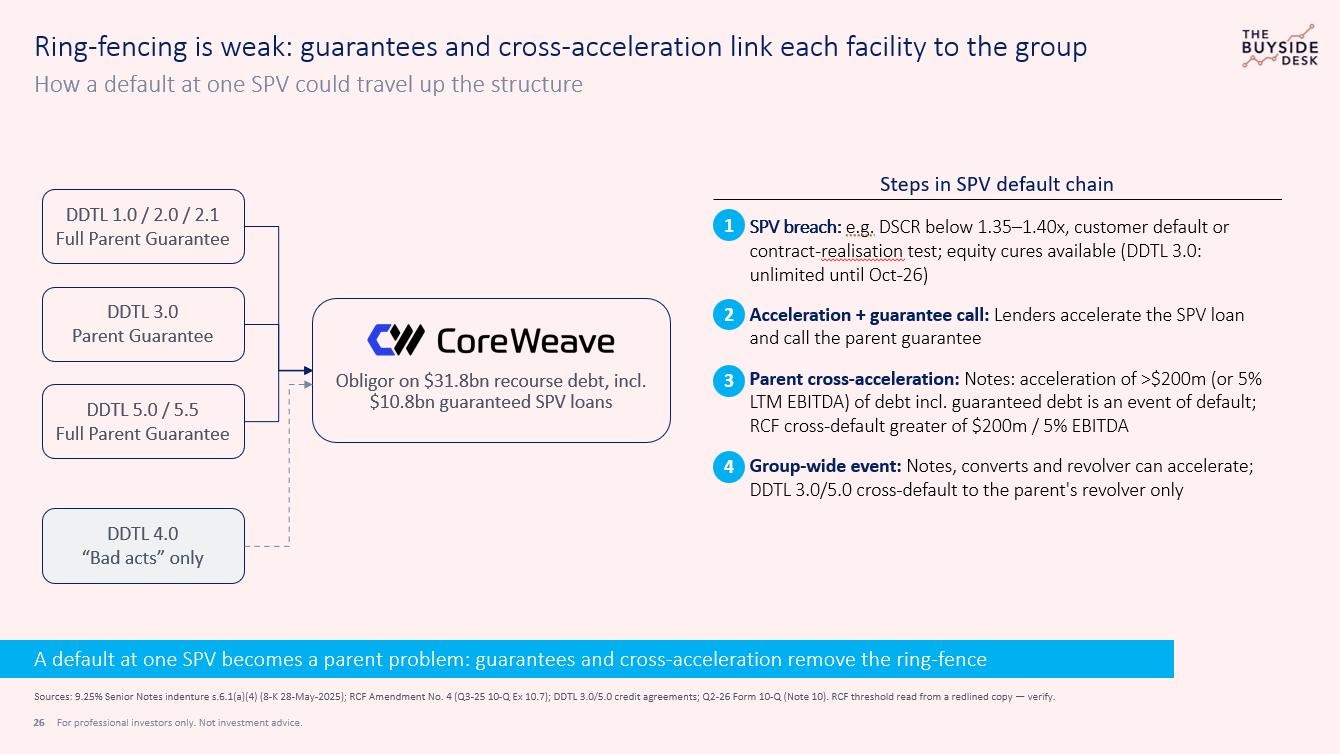
Put the guarantees and the cross-default clauses together, and a problem at one SPV can travel up the whole structure in four steps:
• SPV breach. For example, coverage (DSCR) below its 1.35–1.40x minimum, a customer default, or a failed contract-realisation test. Equity cures are available (on DDTL 3.0, unlimited until 28 October 2026).
• Acceleration and guarantee call. Lenders accelerate the SPV loan and call the parent guarantee.
• Parent cross-acceleration. Under the bond indentures, acceleration of more than $200m (or 5% of LTM EBITDA) of debt, including guaranteed debt, is an event of default. The revolver has a similar cross-default.
• Group-wide event. The bonds, convertibles and revolver can all accelerate.
Where the SPV loans could break
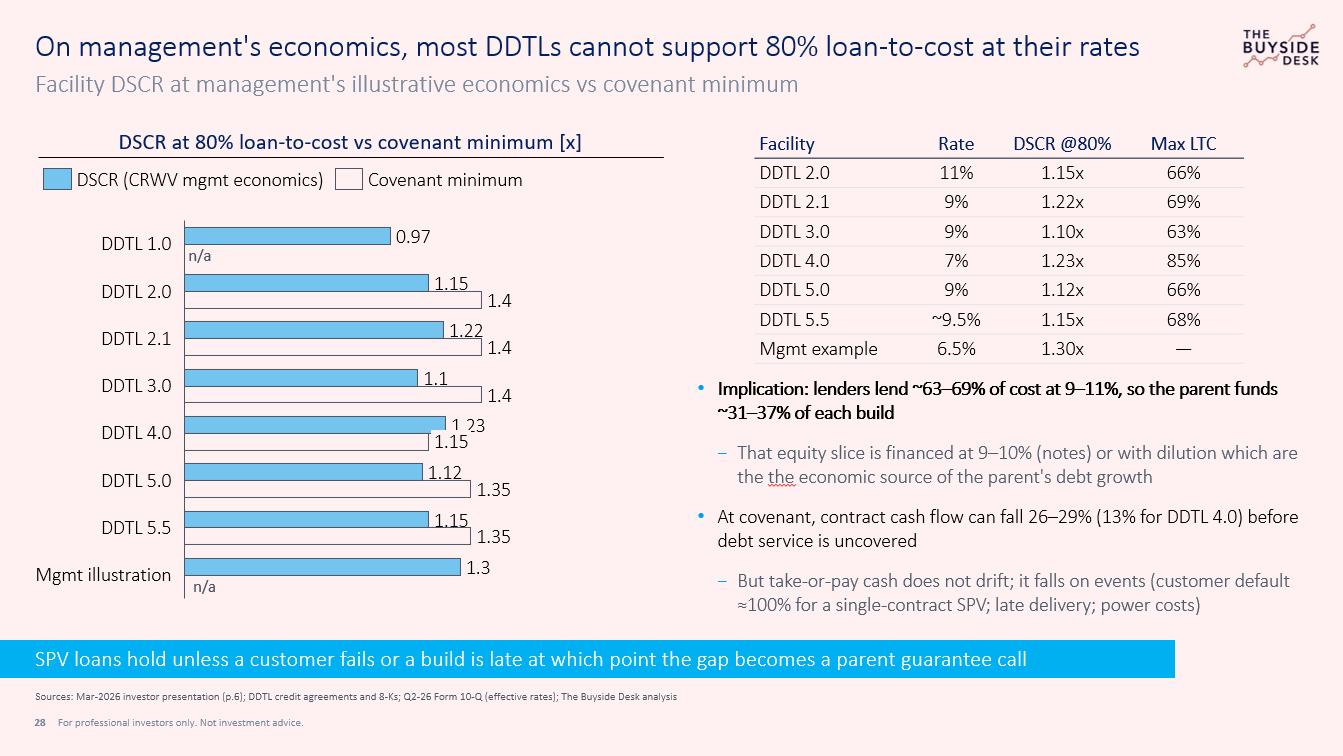
How much cushion does each facility have? We applied management’s own illustrative economics (from Part 1) to each DDTL at an 80% loan-to-cost. At their actual rates, most would not meet their covenant minimum.
In practice, lenders therefore lend about 63–69% of cost at 9–11%, and the parent funds the other 31–37% of each build, at 9–10% or with new shares. That equity slice is the economic source of the parent’s debt growth.
If a facility is sized exactly at its covenant, contract cash flow can fall 26–29% (13% for DDTL 4.0) before debt service is uncovered. That sounds like a comfortable buffer. But take-or-pay cash doesn’t drift down; it falls on events. A customer default can remove close to 100% of a single-contract SPV’s cash flow. Late delivery and higher power costs do damage too. CoreWeave has already amended one facility for delivery timing:
“This amendment to the DDTL 3.0 Credit Agreement aligns the facility for the timing of deliveries described by the Parent on its earnings call reporting financial results for the quarter ended September 30, 2025.” CoreWeave Form 8-K, 31 December 2025
So the SPV loans hold unless a customer fails or a build is late. Then the gap becomes a parent guarantee call.
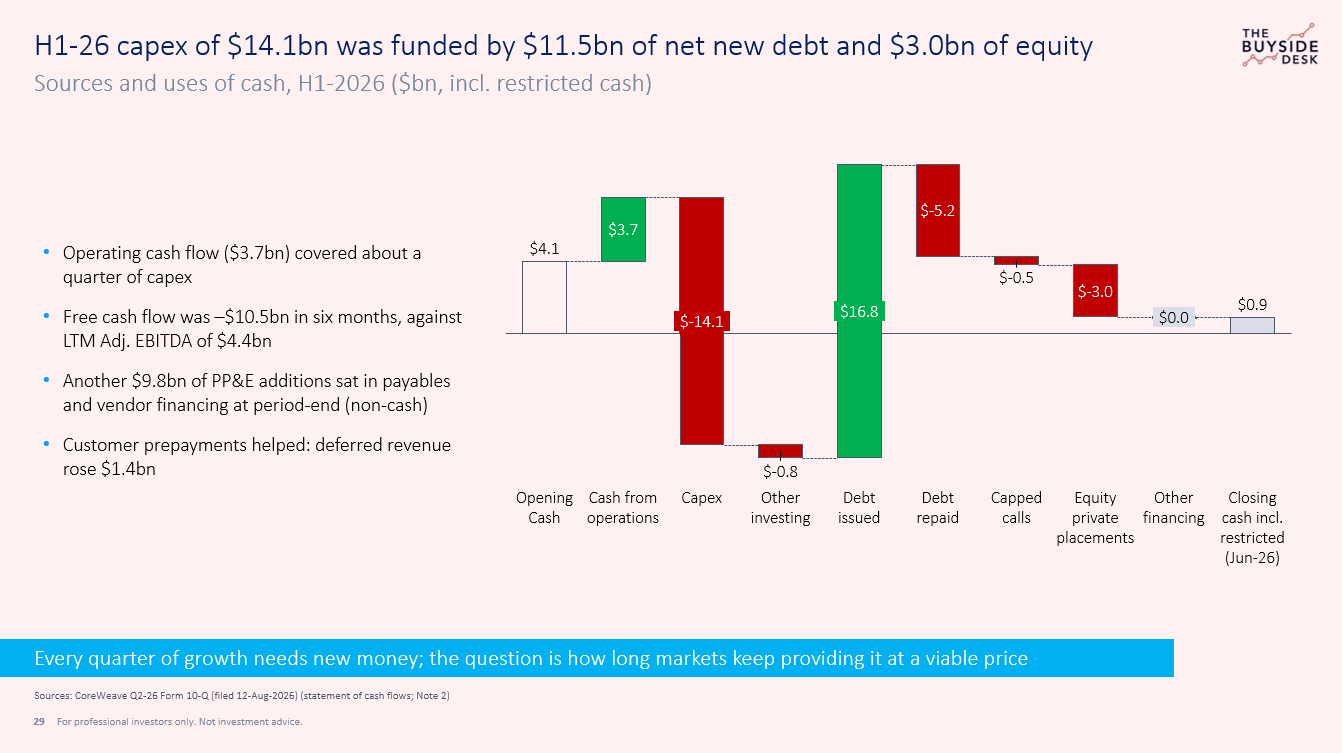
Every quarter of growth needs new money
In the first half of 2026, CoreWeave spent $14.1bn on capex. Operating cash flow covered about a quarter of it ($3.7bn). The rest came from $11.5bn of net new debt and $3.0bn of new equity. Free cash flow was –$10.5bn in six months, against LTM adjusted EBITDA of $4.4bn. Another $9.8bn of equipment additions sat in payables and vendor financing at period end.
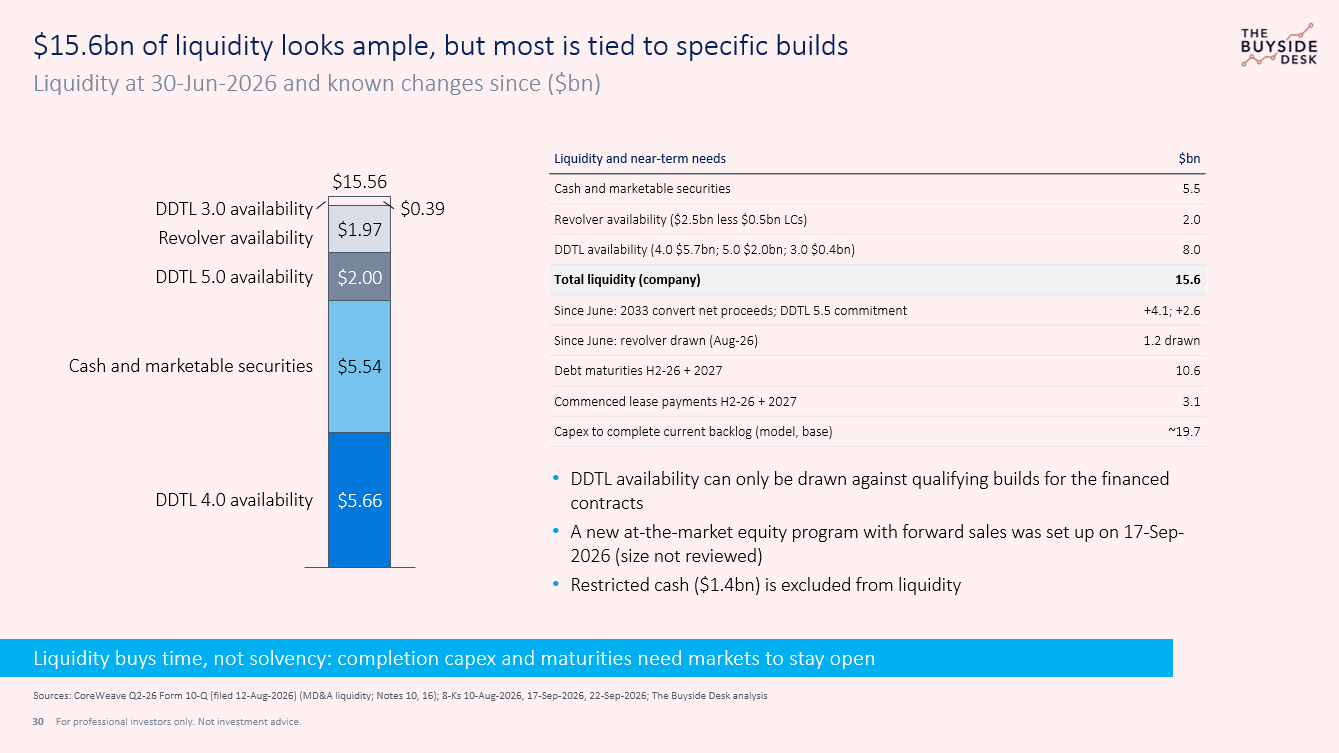
Liquidity of $15.6bn at 30 June looks ample: $5.5bn of cash and securities, $2.0bn of revolver availability and $8.0bn of undrawn DDTLs. But most of it is tied to specific builds; the DDTLs can only be drawn against qualifying projects. Against it sit $10.6bn of debt maturities to the end of 2027, $3.1bn of lease payments on leases already started, and, in our model, about $19.7bn of capex still needed to complete the current backlog. CoreWeave set up a new at-the-market equity programme on 17 September 2026.
Liquidity buys time, not solvency. Completion capex and maturities both need capital markets to stay open.
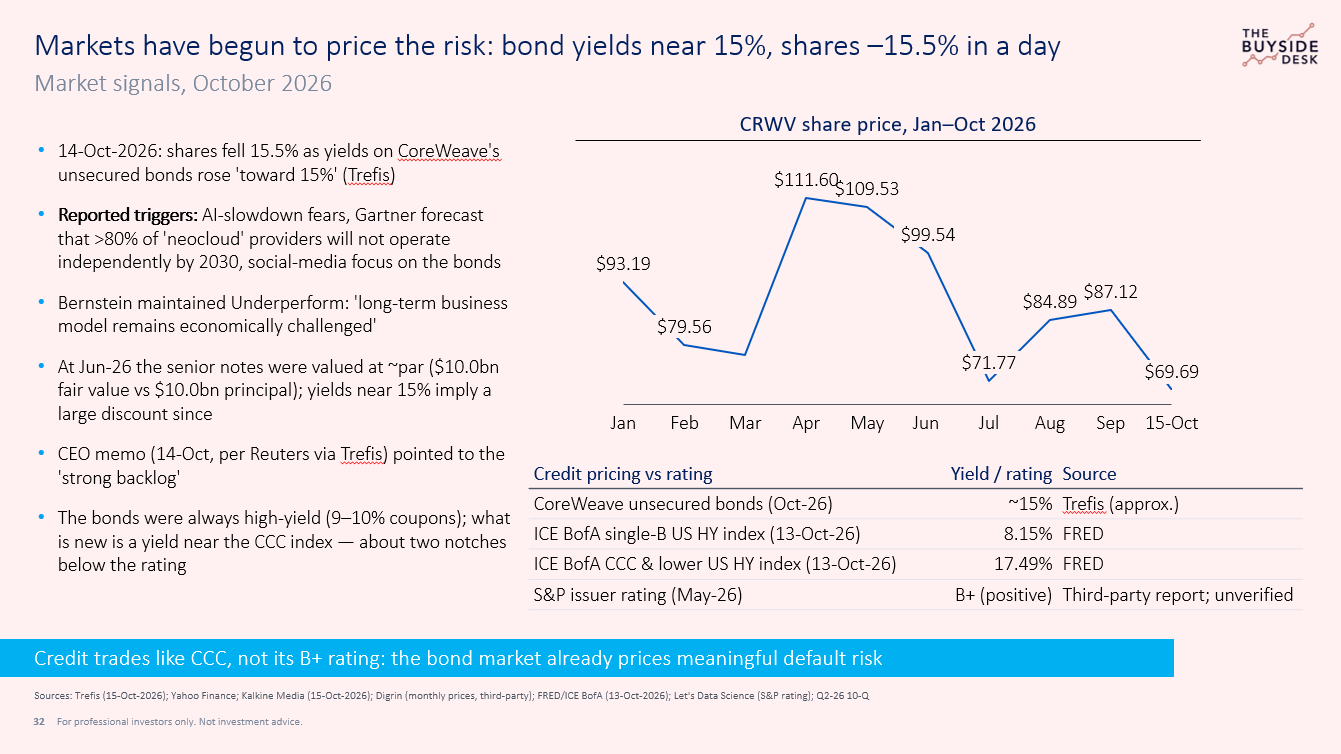
The bond market already prices CCC risk
CoreWeave’s bonds were always high-yield; they carry 9–10% coupons. What is new is where they trade. A yield near 15% puts CoreWeave much closer to the CCC index than to single-B, about two notches below its rating. On 14 October, shares fell 15.5% as those yields rose. Reported triggers included AI-slowdown fears and a Gartner forecast that more than 80% of “neocloud” providers will not operate independently by 2030. Bernstein kept its Underperform rating, calling the long-term business model “economically challenged”.
For shareholders the message is simple: the creditors who rank ahead of them already demand returns that price in meaningful default risk.
One more claim to keep in mind: CoreWeave has $10.8bn of convertible bonds with conversion prices of $97.85–119.60. At $69.69 they are 30–40% out of the money, so for now they behave as cheap debt that has to be refinanced or repaid in 2031–33. If the stock recovered above those prices, they would add about 100m shares (~16%).
CRWV’s financing structure is the issue
CoreWeave’s debt is large, but its structure is the bigger issue. $51.9bn ranks ahead of shareholders. The “asset-level” loans are guaranteed by the parent. One SPV’s failure can trigger the parent’s bonds. Leases add about $80bn of fixed commitments that outlast the contracts. And the bond market already prices the company close to CCC.
None of that means default is imminent: liquidity was $15.6bn in June. It means shareholders stand at the back of a long queue, behind creditors who are already nervous. In Part 3 we ask the decisive question: can the contracts CoreWeave already has pay for all of this?