

CoreWeave CRWV 0.00%↑ has been one of the darlings of the AI boom. A “neo-cloud” promising new solutions to the AI cloud computing challenges of the future. Their growth has been astonishing and rapid and has used leverage to a degree rarely seen with public companies. This has led to a chorus of naysayers predicting the company’s imminent demise and an equally vocal chorus of supporters pointing to market demand, opportunities and potential riches.
The stock has been of high interest at The Buyside Desk, as we contemplated taking a position in the company. Our analyst research has dissuaded us of that idea. We took a deep dive into CRWV’s debt by rebuilding every debt instrument from the filings (10-Qs, 10-K, credit agreements and bond indentures) and stress-tested whether today’s contracts can carry today’s obligations. We did not like what we saw. This four-part series walks through the result.
To be clear, there is a Bull scenario in which the shares appreciate significantly from today’s price. But this is not our base case and we think the risks to not justify the rewards.
We rate CRWV a “SELL” and have a $0 price target. This is an unusual call for us - we are not used to looking at possible $0 “wipeout” scenarios. But this is what we found.
This is the first article in a 4-part series on CoreWeave; after which we will make our full 62-page analyst deep dive deck available along with our valuation model. If you find this content valuable, please consider subscribing. There will be many deep dives to come and the value of this research will be obvious to investors.
Now to Part 1: Is CoreWeave stock worthless?
On 14 October 2026 CoreWeave shares fell 15.5% in a day, as yields on its unsecured bonds rose “toward 15%”. The next day the stock traded at $69.69, valuing the equity at about $42.5bn and the whole business, including net debt, at about $73bn. It seemed the bond market was reacting to something equity investors tend to skip (spoiler alert: CRWV’s debt).
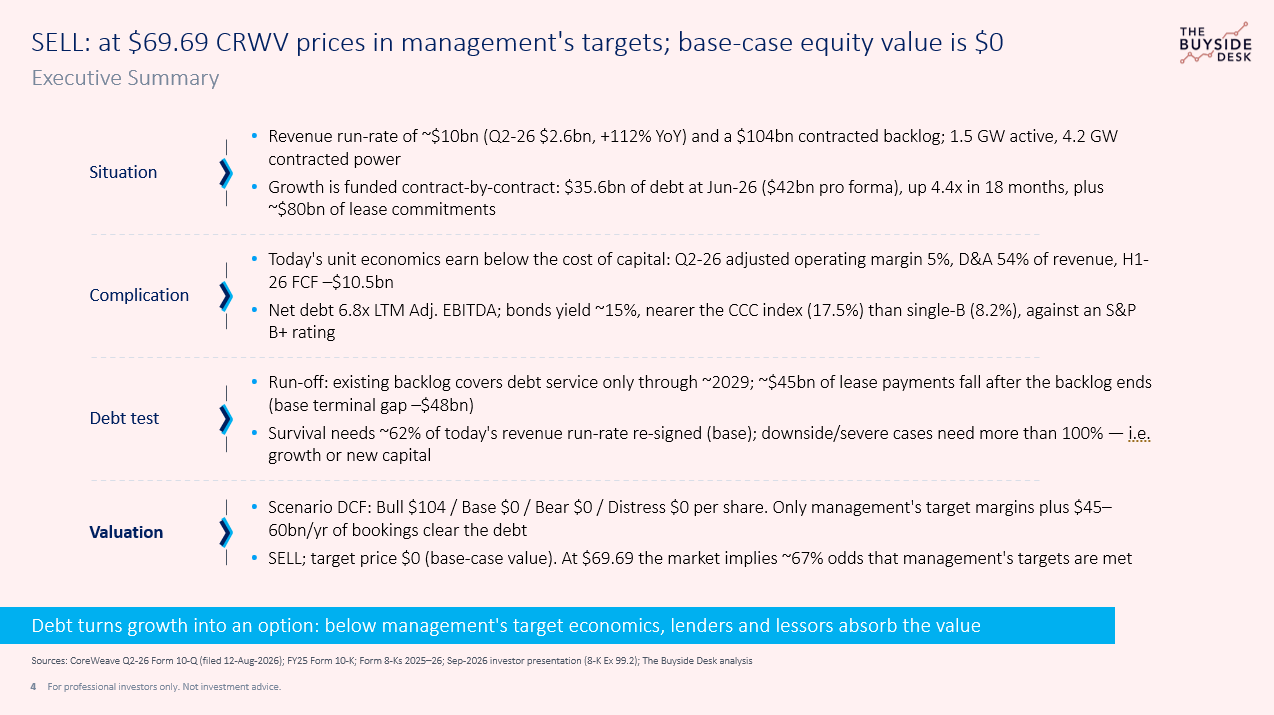
CoreWeave is AI’s fastest-growing cloud: a $104bn contracted backlog, 1.5 GW of active power and 4.2 GW contracted. But it funds that growth contract by contract with borrowed money. Debt reached $35.6bn at the end of June ($42bn pro forma for deals since), up 4.4x in 18 months, on top of about $80bn of lease commitments.
The company says it plainly in its own filing:
“Our substantial indebtedness could materially adversely affect our financial condition, our ability to raise additional capital to fund our operations, our ability to operate our business…” CoreWeave Q2-26 Form 10-Q
So the question for shareholders is not whether CoreWeave is growing. It is who owns the value that growth creates: shareholders, or the lenders and landlords who fund it?
Our call: “SELL” with a $0 base case price target
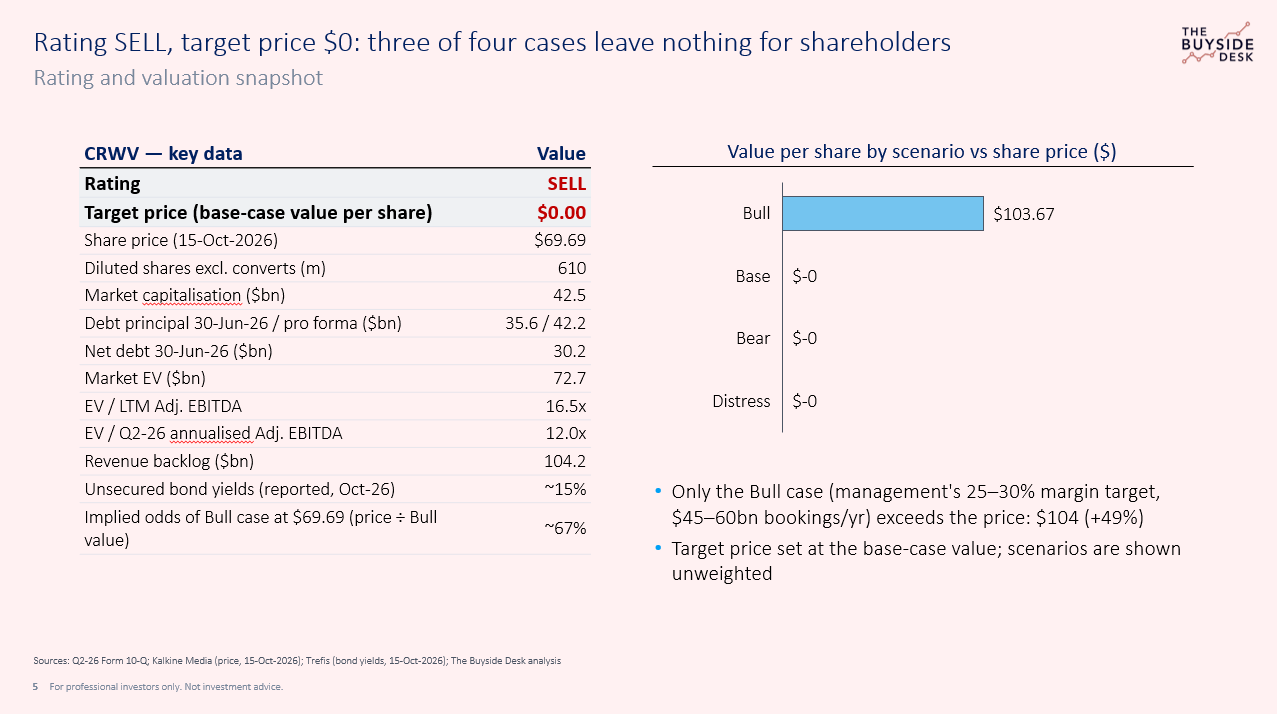
Our base-case DCF leaves nothing for shareholders. Three of our four scenarios value the equity at zero; only management’s own targets (our Bull case, $104 a share) beat the $69.69 share price. However, we should note that our $0 target is a base-case valuation, not a prediction that the shares go to zero next month. It says that at today’s economics the business is worth less than its debt. At $69.69 the market is pricing roughly two-in-three odds that management hits its targets ($69.69 ÷ $103.67, before time value).
Our analysis built 4 scenarios, with the Bull scenario the only one leaving any value for shareholders (actually a decent gain from today’s share price). We show the scenarios side by side and do not weight them. It is unusual for our base case to be $0 for any company we look at (our screens typically filter out potential wipe-outs pretty early) but $0 is simply what our base case says. In that case CoreWeave’s enterprise value is $3.4bn against net debt of $30.2bn. The business has value; the equity, which ranks behind every creditor, does not.
That makes CoreWeave stock behave like a call option on management’s targets. It pays off well if they are met, and is worth little or nothing if they are not.
What CoreWeave sells
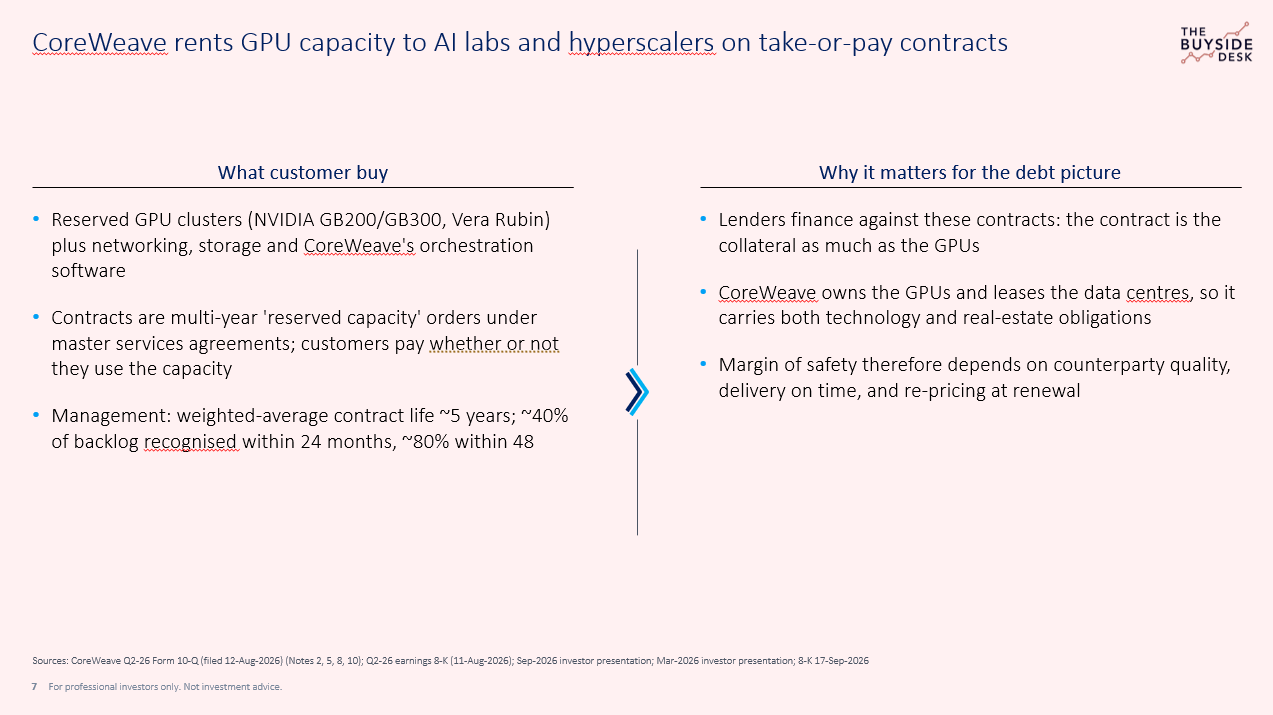
CoreWeave rents out computing power for AI. Customers reserve clusters of NVIDIA GPUs (the GB200/GB300 generation and the coming Vera Rubin), together with networking, storage and CoreWeave’s own software to run them.
The key feature is the contract. Customers sign multi-year “reserved capacity” orders and pay whether or not they use the capacity: a take-or-pay arrangement. Management puts the weighted-average contract life at about five years, with about 40% of the backlog recognised within 24 months and about 80% within 48.
That contract is what makes the financing possible. Lenders lend against it: the contract is as much the collateral as the GPUs. But CoreWeave owns the GPUs and leases the data centres, so it carries both technology risk and real-estate obligations. Its margin of safety depends on three things: customers paying, capacity being delivered on time, and contracts being renewed at good prices.
The growth is real; the profit is not, yet
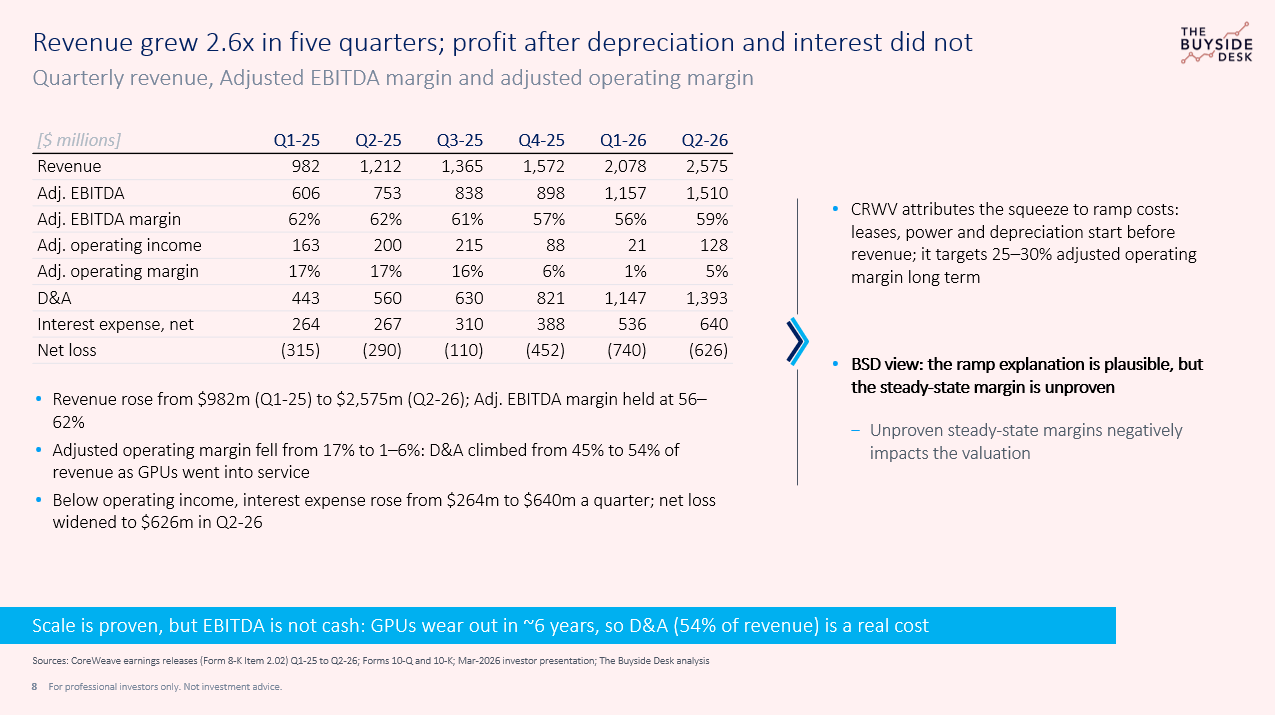
Revenue rose from $982m in Q1-25 to $2,575m in Q2-26, 2.6x in five quarters. Adjusted EBITDA margins held near 60%. On that metric, CoreWeave looks like a highly profitable business. But the problem is that EBITDA leaves out the biggest cost of the business. GPUs wear out, or are overtaken, in about six years, and depreciation is how that cost shows up. D&A rose from 45% to 54% of revenue as new GPUs went into service, and the adjusted operating margin fell from 17% to 5%. Below that, interest expense climbed to $640m a quarter, about 5x adjusted operating income, and the net loss widened to $626m.
Management attributes the squeeze to ramp costs: leases, power and depreciation start before revenue does. It targets a 25–30% adjusted operating margin in the long run. That explanation is plausible. But the steady-state margin is unproven, and it is the single assumption that decides the valuation (coming in part 4).
A $104bn backlog with a few names behind it
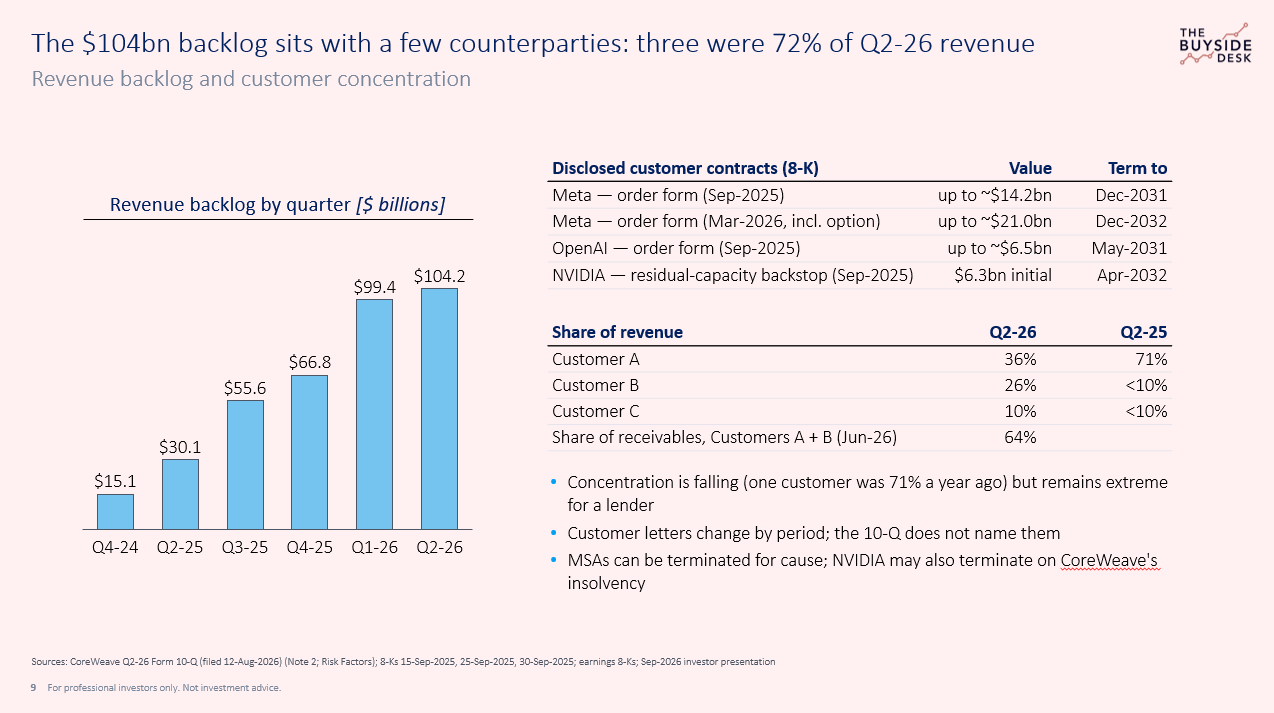
We have to admit that CRWV’s backlog is extraordinarily impressive in its size, especially given the company’s relative youth. Indeed, this was the figure that initially tempted The Buyside Desk to have a deeper look at the company. After all, how often do you see a company with a backlog growing from practically nothing to $100+ billion in a only a few years. By the end of 2024, the backlog was a “mere” $15.1bn. By June 2026, this figure stood at $104.2 billion. “Astonishing” seemingly downplays the growth. Under the headlines, we see that a handful of very large contracts drive it. The ones CoreWeave has disclosed in 8-K filings: Meta (Sep 2025) for ~$14.2 billion to Dec 2031, Meta (Mar 2026, incl. option) for $21 billion to Dec 2032, OpenAI (Sep 2025) for $6.5 billion to May 2031, Nvidia (Sep 2025, residual capacity backstop) for an initial $6.3 billion to Apr 2032.
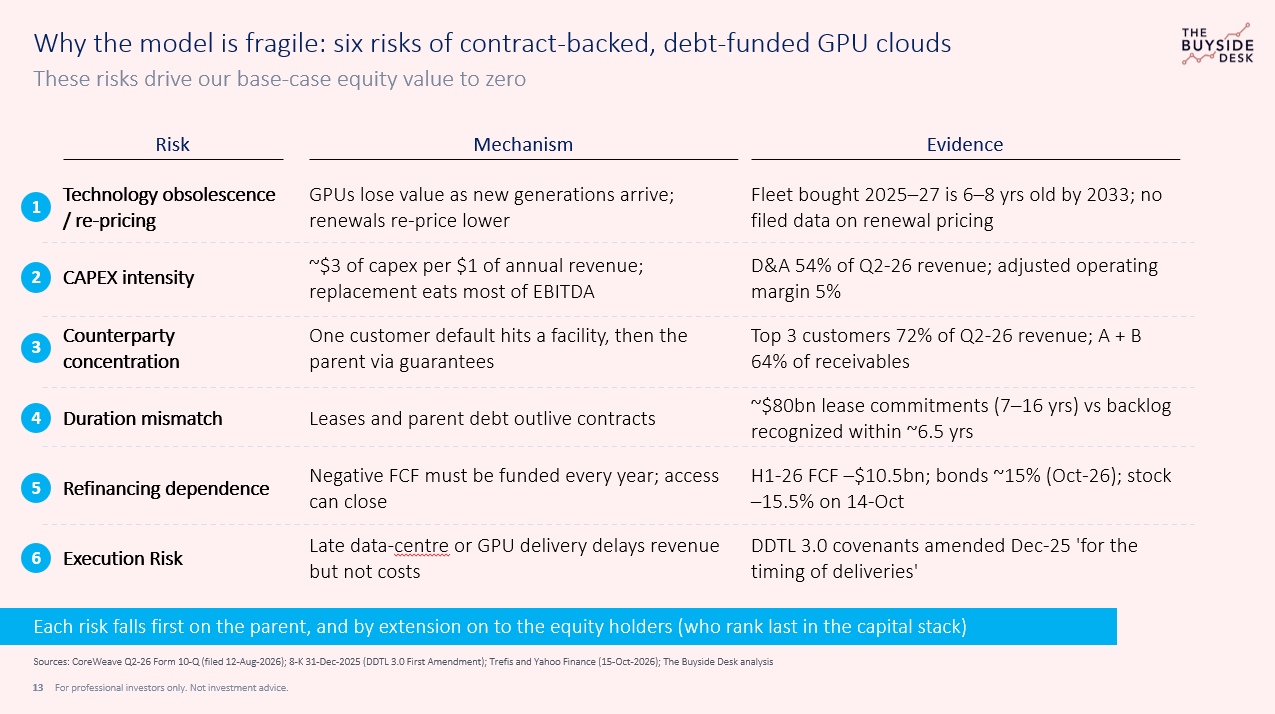
Concentration is falling, but it is still high. CoreWeave’s three largest customers made up 36%, 26% and 10% of Q2-26 revenue. A year earlier, one customer accounted for 71%; the 2025 filings named it as Microsoft. The 2026 filings no longer name the top customers, and the letters (A, B, C) can refer to different customers from one quarter to the next. Customers A and B also held 64% of receivables at the end of June.
“A substantial portion of our revenue is driven by a limited number of customers.” CoreWeave Q2-26 Form 10-Q
For shareholders, a big backlog is good news. For a lender, concentration is the risk that matters: if one customer stops paying, the facility financed against its contract loses most of its cash flow. Part 2 shows how that loss would travel up to the parent.
Management’s own example doesn’t work at CoreWeave’s borrowing costs
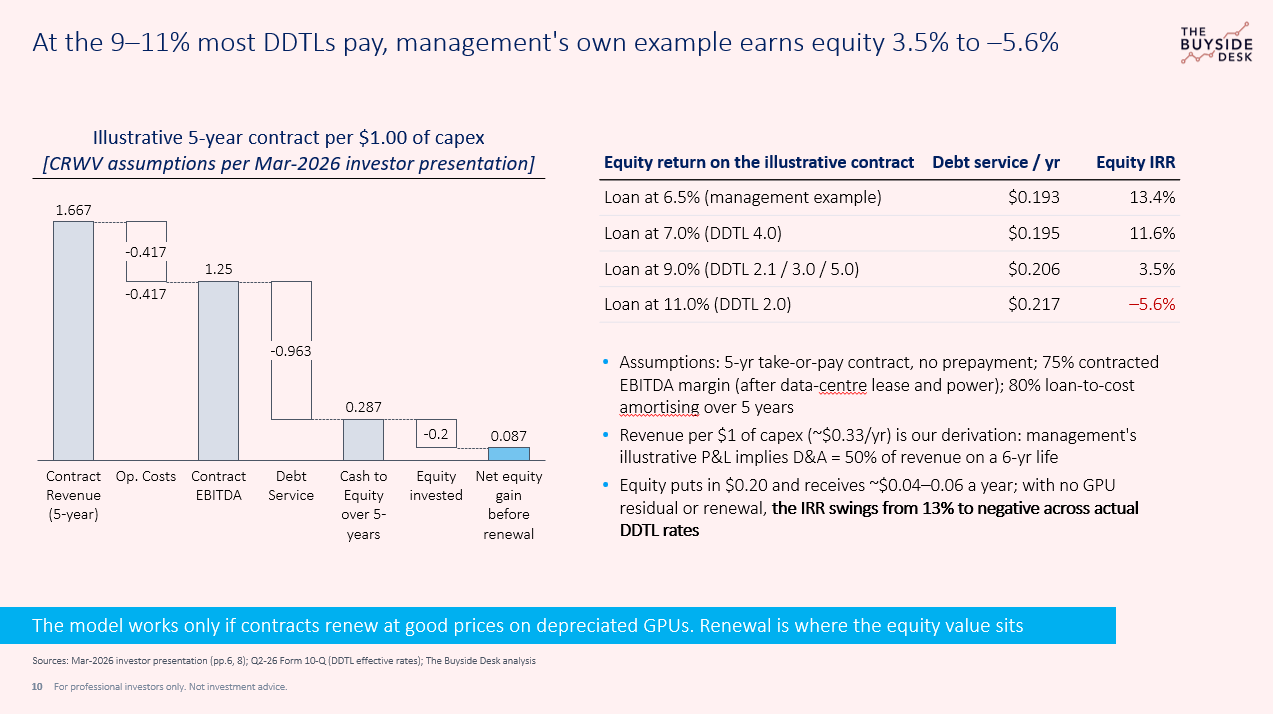
In its March 2026 investor presentation, CoreWeave walks through the economics of a single contract. Per $1.00 of capex: a five-year take-or-pay contract, about a 75% contract EBITDA margin after data-centre lease and power, and a loan for 80% of the cost at 6.5%, repaid over the contract.
On those numbers the contract repays its loan and the equity earns a 13.4% return. The problem is the 6.5%. Most of CoreWeave’s asset-level loans (its delayed-draw term loans, or DDTLs) cost 9–11%. So we re-ran management’s example at the rates CoreWeave actually pays. It turns out that at 9–11%, the contract on its own earns the equity between 3.5% and –5.6%. Equity puts in $0.20 per $1.00 of capex and gets back only $0.04–0.06 a year. There is no profit until the contract is renewed on GPUs that are by then fully or largely depreciated. Renewal, in other words, is where the equity value sits.
How each build is financed
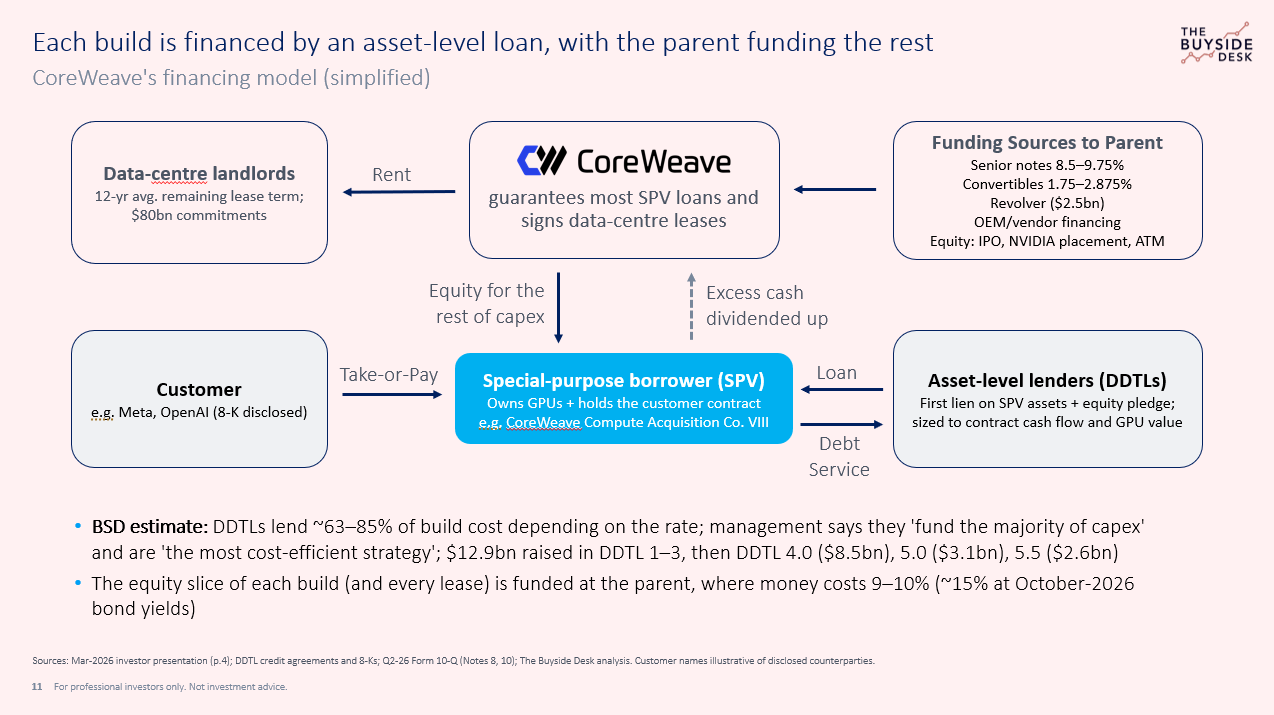
Every large contract gets its own special-purpose vehicle (SPV). The SPV owns the GPUs and holds the customer contract. An asset-level lender provides a delayed-draw term loan secured on the SPV’s assets and sized to the contract’s cash flow. The customer pays the SPV, the SPV services the loan, and any excess cash goes up to the parent. And CRWV’s management is clear that this is the core of its funding:
“Asset-level delayed draw term loans will remain the primary source of financing utilized to fund CoreWeave’s continued hypergrowth, which is the most cost-efficient strategy for financing the business.” - CoreWeave investor presentation, March 2026
What the loans don’t cover lands on the parent, CoreWeave, Inc. We estimate the DDTLs lend about 63–85% of build cost, depending on the rate. The rest of each build, and every data-centre lease, is funded at the parent: senior notes at 8.5–9.75%, convertible bonds, vendor financing and new equity. At October 2026 bond yields, new parent debt would cost about 15%.
The core risk: three clocks running at different speeds
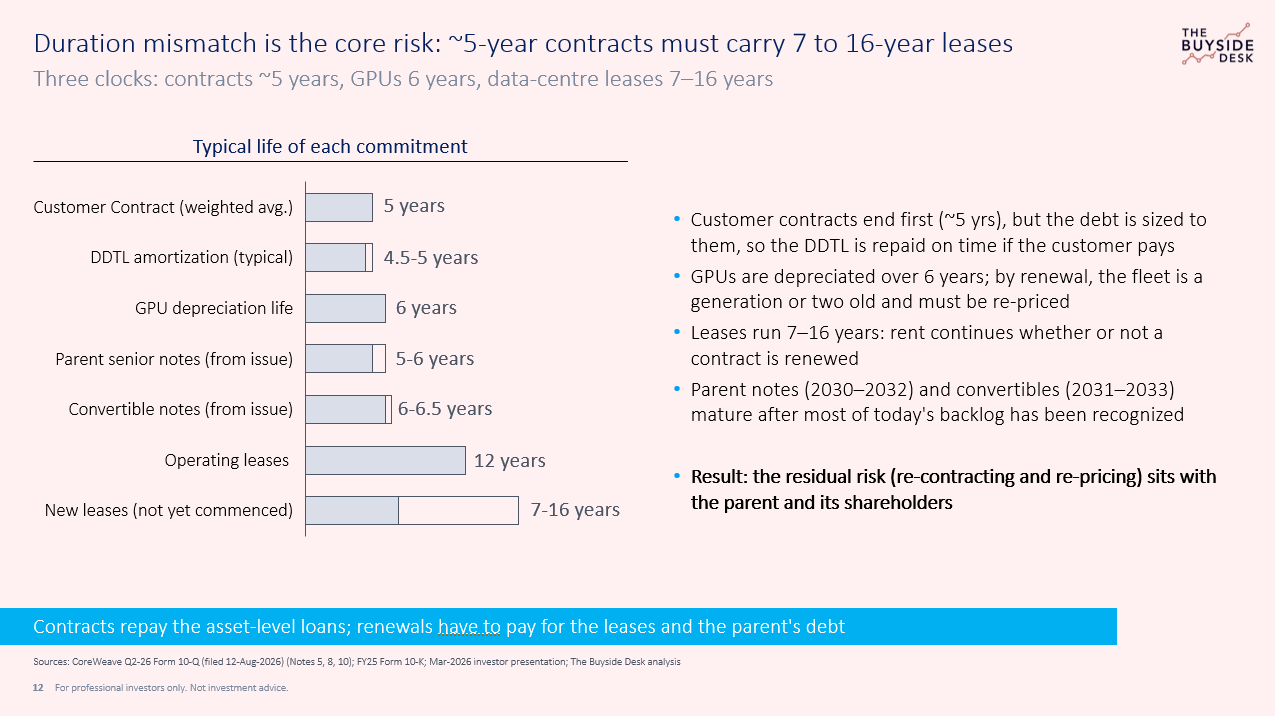
The structure has a timing problem built into it. Three commitments run on three clocks that create a classic duration mismatch.
Customer contracts: ~5 years. The asset-level loan is sized to the contract, so it is repaid on time if the customer pays. GPUs: 6-year depreciable life. By the time a contract ends, the fleet is a generation or two old and has to be re-priced. Data-centre leases: 7–16 years. Rent continues whether or not a contract is renewed. Existing leases have about 12 years left on average.
The parent’s bonds (due 2030–32) and convertibles (2031–33) also fall due after most of today’s backlog has been recognised. So the contracts repay the asset-level loans, but renewals have to pay for the leases and the parent’s debt. The residual risk of re-contracting and re-pricing sits with the parent, and therefore with its shareholders.
Putting this together, the CRWV’s business has 6 “weak points” that are clearly visible to investors and that fall on the shareholders, who should not need to be reminded sit last in the capital structure.
There is a $52 billion queue ahead of CRWV shareholders
CoreWeave is a real business with real customers and very real growth. But it is funded in a way that hands most of the value of that growth to lenders and landlords unless the economics improve a lot. On management’s own example, a contract financed at CoreWeave’s actual rates barely earns its equity back. Leases and parent debt outlast the contracts that service them.
That is why our base case values the equity at zero, and why the stock behaves like an option on management’s targets.
To be continued: Part 2 of our analysis into CRWV will open up the balance sheet and break down the $51.9bn of debt and leases ranking ahead of shareholders. We will also look at CRWV’s parent guarantees, and a bond market that already prices CoreWeave close to “junk”.