

One feature of CoreWeave that attracts potential and existing investors is the size of their backlog. “Impressive” undersells it. This is a company that has gone from zero to $104 billion in order backlog in just a few short years. Their issue is not growth (CRWV’s growth is astonishing), it is the debt used to finance that growth. This will likely leave nothing for shareholders, and we have a $0 price target on CRWV shares.
Part 1 and Part 2 of this series introduced CRWV’s financing structure, challenges and how shareholders are likely to be wiped out. In this Part 3, we support our “SELL” rating further by showing that even their incredible $104 billion backlog is not enough to pay the bills. To begin, we ask a simple question:
What if CoreWeave stopped signing new customers today?
Management argues that the backlog is the security behind the debt. So we tested that directly. We took the contracts CoreWeave has today (the $104.2bn backlog at June 2026) and asked whether they alone can pay the obligations CoreWeave has today. That means debt service, all lease payments including leases not yet started, and the capex needed to finish the capacity those contracts require.
The test deliberately excludes new contracts (including more than $25bn signed early in Q3) and renewals, which we test separately. If today’s contracts cover today’s obligations, the debt is backed by contracts. If they don’t, the debt depends on future growth and access to capital markets.
We ran 3 cases: Base, Downside and Severe with assumption scenarios for Backlog realization, EBITDAR margin (before leases), Capex per $1 of peak revenue, Cost of Debt, Parent bonds refinanced at maturity and Residual GPU value (2032). To be clear, we are taking some assumptions into consideration. For instance, residual GPU values are hotly contested between bearish investors and CRWV’s management forecasts. But we think our assumptions are valid based on the best information available to us.
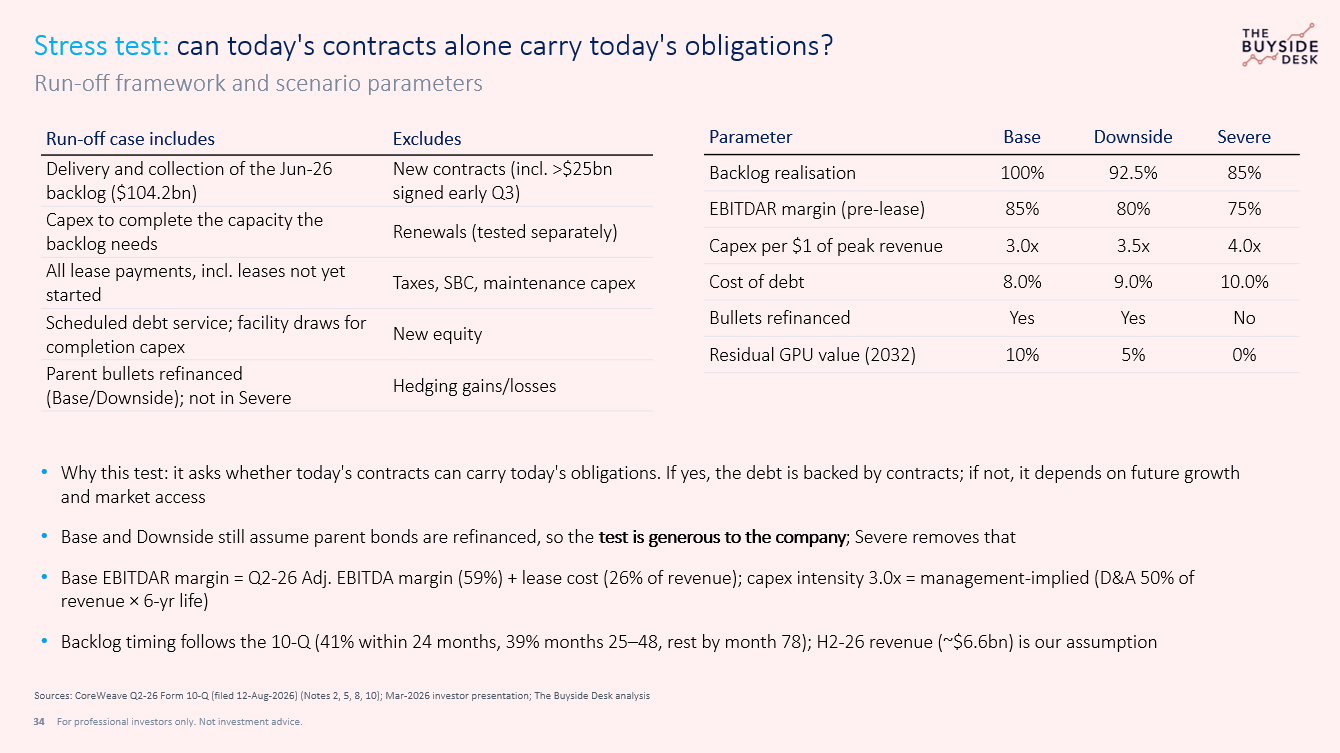
Note that the base and downside cases assume the parent’s bonds are refinanced when they mature. That makes the test generous to CoreWeave; only the severe case removes it. The base EBITDAR margin is Q2-26’s 59% adjusted EBITDA margin plus lease costs (26% of revenue), and the 3.0x capex intensity is what management’s own illustration implies.
Coverage holds until 2029, then fails
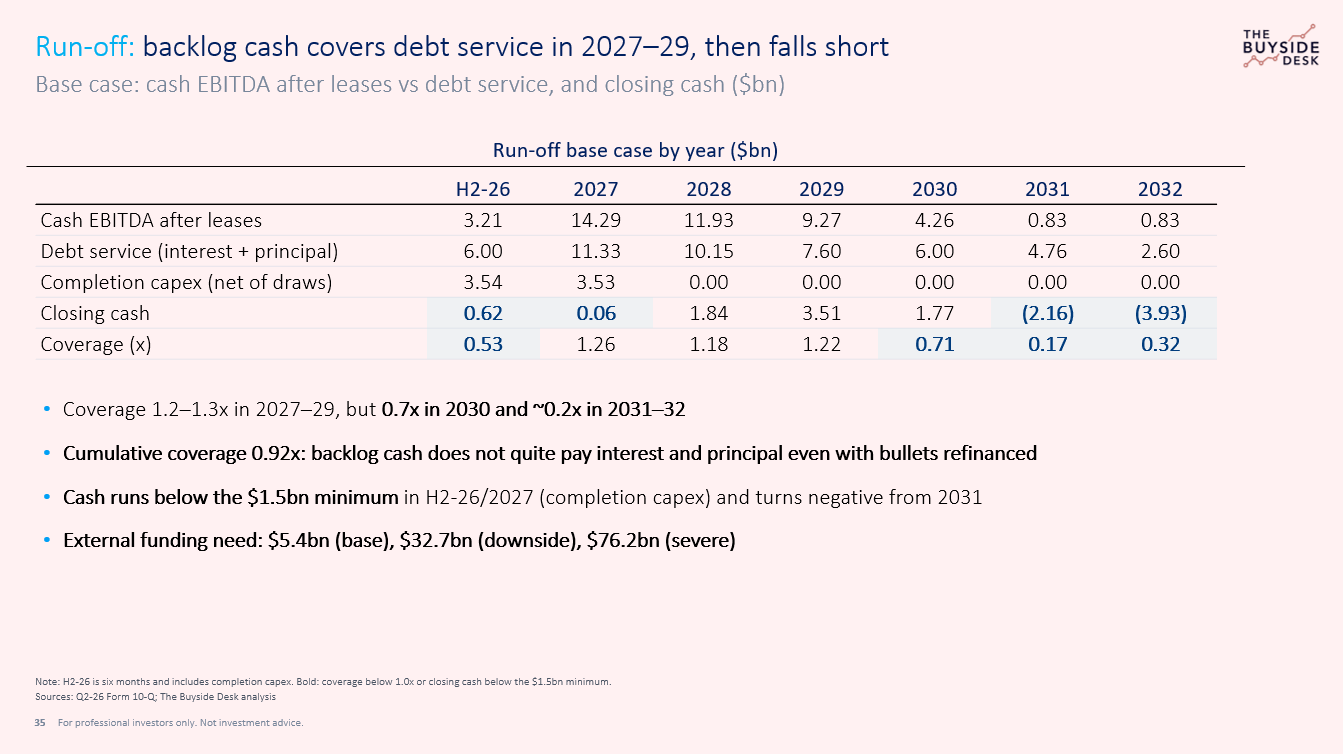
In the base case, cash from the backlog covers debt service comfortably in the middle years, then runs out as contracts end. Coverage is 1.2–1.3x in 2027–29, but 0.7x in 2030 and about 0.2–0.3x in 2031–32. Across the whole period, backlog cash covers only 0.92x of interest and principal, even with the parent’s bonds refinanced.
The first squeeze comes even earlier. Cash falls below a $1.5bn operating minimum in H2-26 and 2027, because CoreWeave still has to finish building the capacity its contracts require. Those shortfalls come before any contract expires, so renewals can’t cure them; only new capital can. Even the base case needs $5.4bn of external funding.
The lease tail outlives the backlog
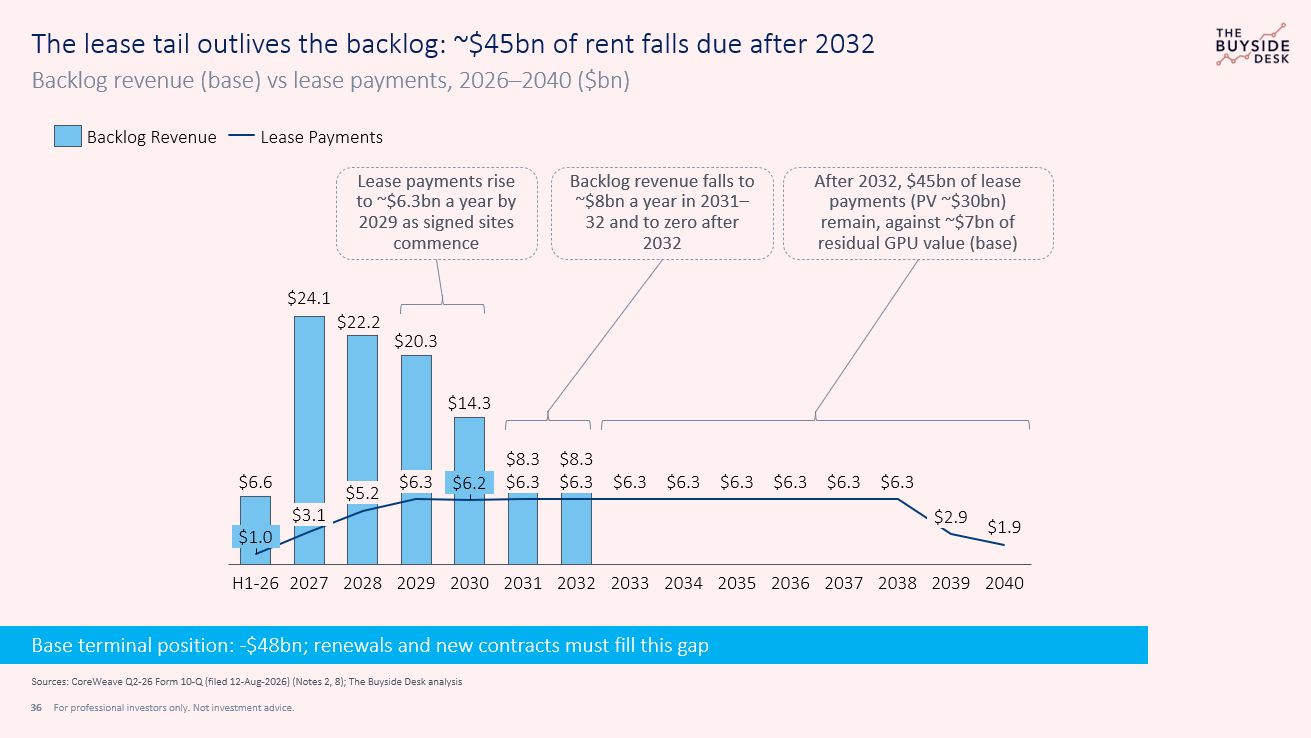
Revenue from today’s backlog peaks at about $24bn in 2027, falls to about $8bn a year in 2031–32 and to zero after 2032. Lease payments do the opposite: they rise to about $6.3bn a year by 2029 as signed sites come online, and stay there.
After 2032, about $45bn of lease payments remain (about $30bn in present value), against roughly $7bn of residual GPU value in the base case. That leaves a base-case terminal position of –$48bn: a gap that renewals and new contracts must fill.
Every scenario leaves a gap
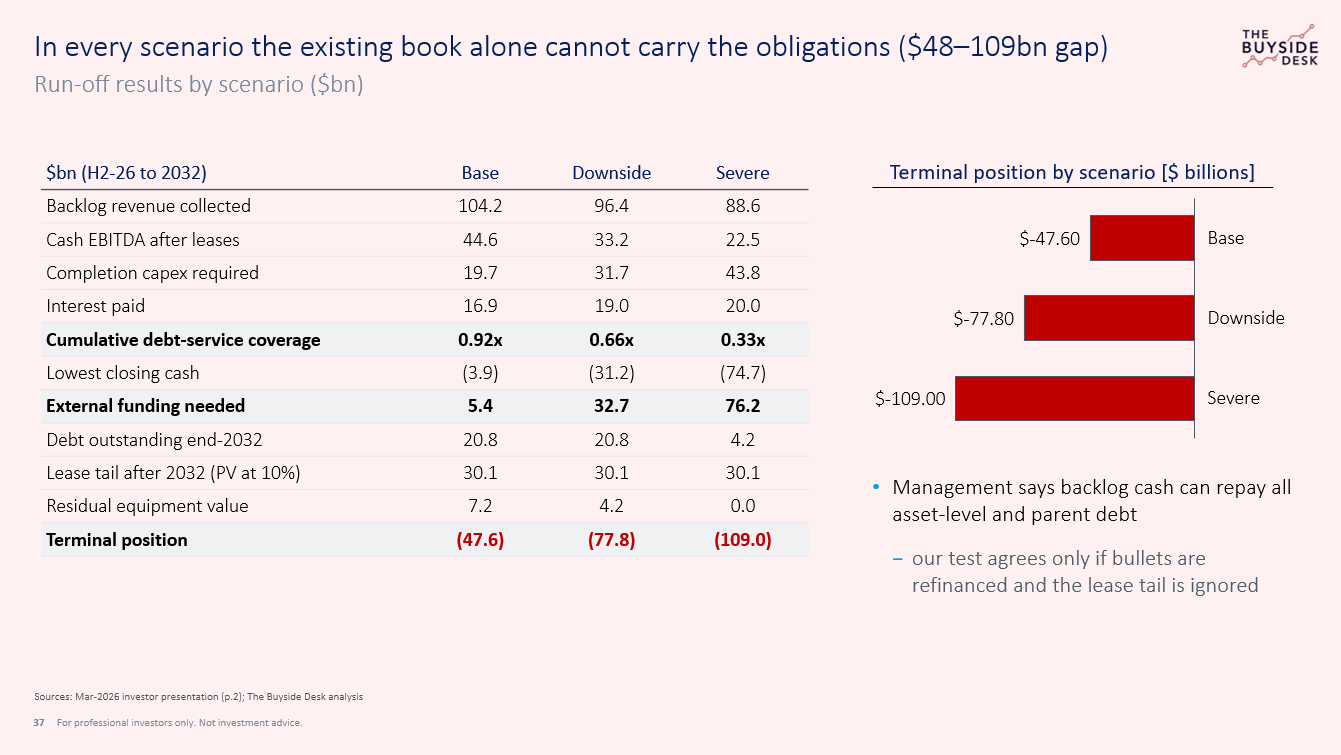
Management says backlog cash can repay all of CoreWeave's asset-level and parent debt. Our test agrees only if the parent's bonds are refinanced and the lease tail is ignored. Include the leases, and the existing book alone cannot carry the obligations in any scenario.
Renewals decide everything
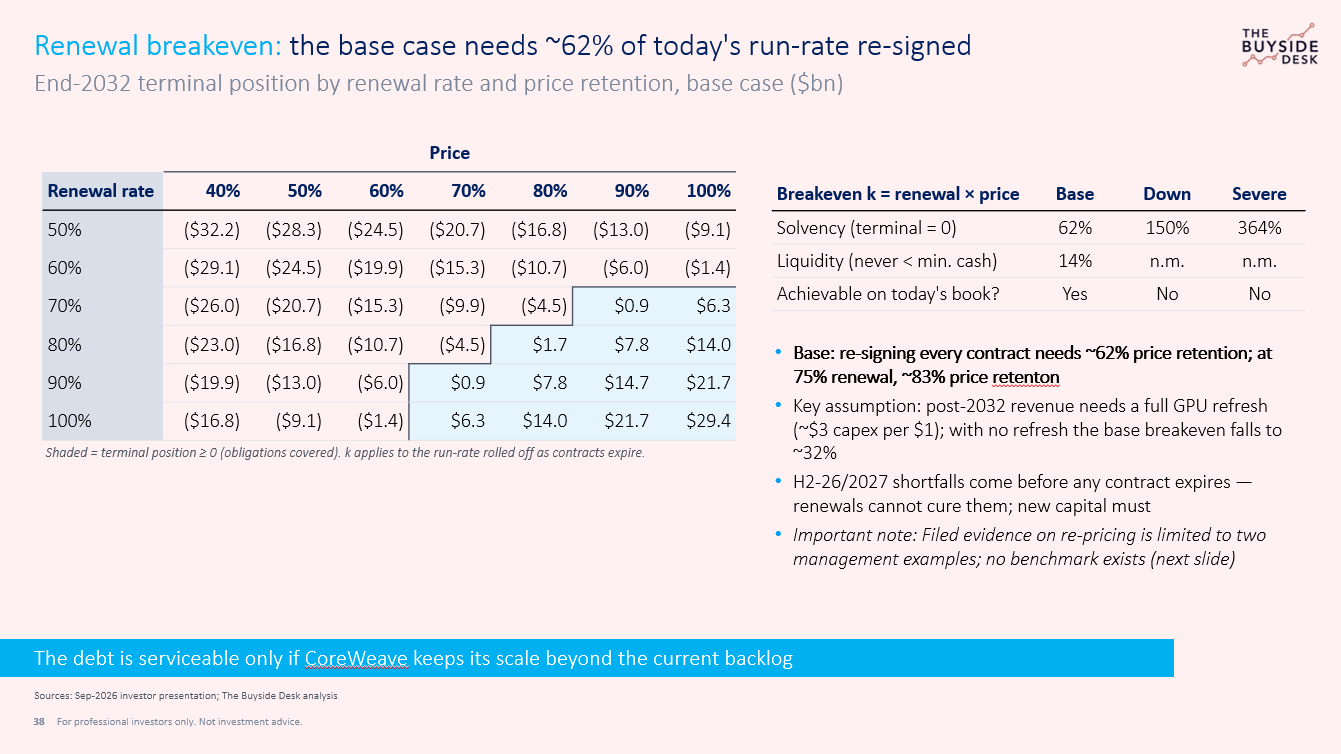
If today’s contracts aren’t enough, how much renewal is? We measure renewal as k = renewal rate × price retention: the share of expiring revenue that comes back. Re-signing 80% of contracts at 90% of the original price is a k of 72%.
In the base case, the 2032 gap closes at a k of about 62%. If every contract renews, prices can fall about 38%; if only 75% renew, prices have to hold at about 83% of the original. In the downside and severe cases the breakeven is 150% and 364%. That is impossible from renewals alone and needs growth or new capital.
Is 62% achievable? Nobody knows yet (and shareholders should not risk it)
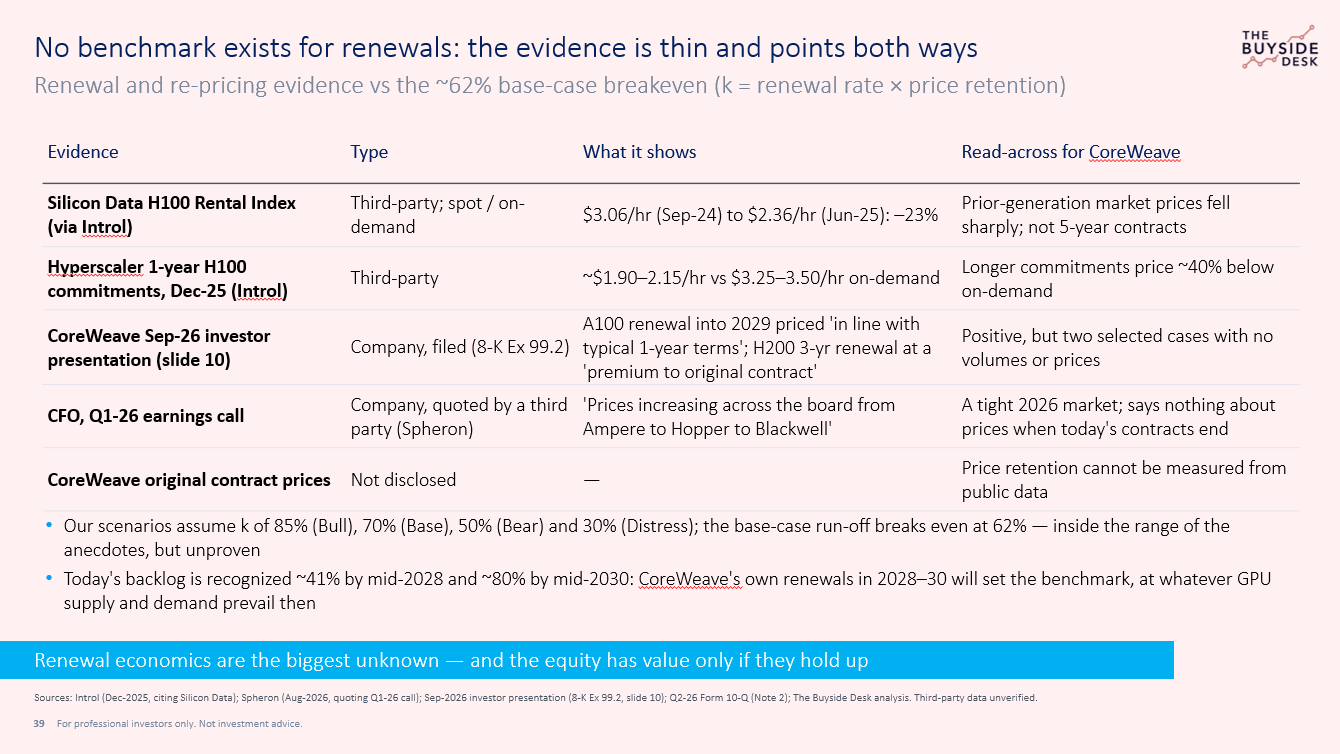
This is the honest answer, and it is the biggest uncertainty in the whole analysis. GPU clouds on multi-year take-or-pay contracts are only a few years old, so no history of long-term renewals exists. CoreWeave’s September presentation describes the two renewals like this:
A100 (launched 2020): “Renewal Term Extends into 2029 … 3-year contract signed in line with typical 1-year terms.” H200 (launched 2023): “Renewal Term 3 Years … Premium to original contract.” CoreWeave investor presentation, September 2026 (8-K Exhibit 99.2)
Our scenarios assume k of 85% (Bull), 70% (Base), 50% (Bear) and 30% (Distress). The base-case breakeven of 62% sits inside the range of the anecdotes, but it is unproven. About 41% of today’s backlog is recognised by mid-2028 and about 80% by mid-2030. CoreWeave’s own renewals in 2028–30 will set the benchmark, at whatever GPU supply and demand look like then.
Renewal economics are the biggest unknown, and the equity has value only if they hold up.
Buyside Desk’s conclusion: the debt is not self-sustaining
This insight is critical for investors (and potential investors) to grasp. “Not self-sustaining” is not the same as “about to default”. It means the debt survives only if three things keep happening: CoreWeave keeps growing, its contracts renew at good prices, and capital markets stay open to it.
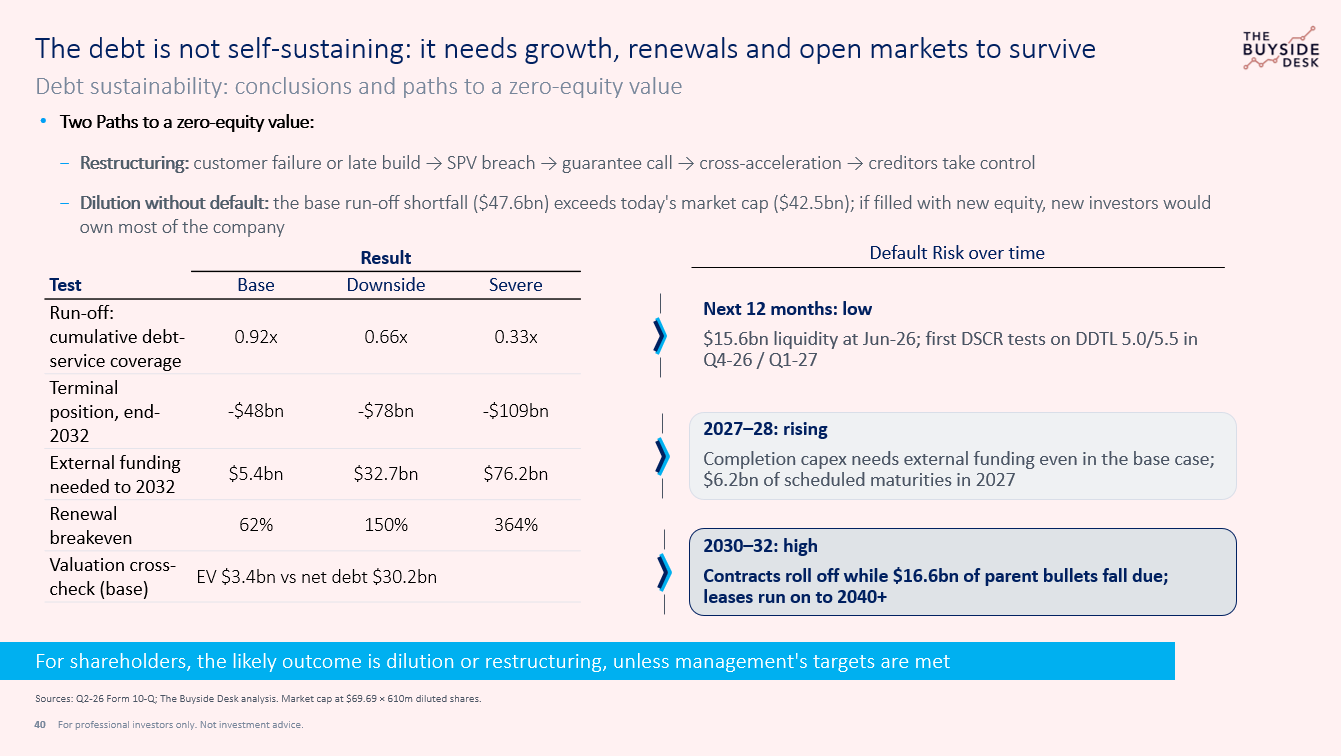
If they don’t, there are two paths to a zero equity value (neither are good for shareholders): Restructuring or Dilution. A restructuring scenario would start with a customer failure or a late build leads to an SPV breach, then a guarantee call, then cross-acceleration of the parent’s debt. Then the creditors take control (bad for shareholders). A dilution scenario (without a default) is perhaps more likely, but no more appealing for investors. The base-case shortfall ($47.6bn) is larger than today’s market capitalization ($42.5bn). If it is filled with new equity, new investors would end up owning most of the company.
These risks build over time rather than all at once. For the next 12 months, there appears to be sufficient room for CRWV to maneuver: $15.6bn of liquidity at June 2026. First coverage tests on DDTL 5.0 and 5.5 in Q4-26 and Q1-27. This is when things get interesting, as the risk rises in 2027-28. Completion capex needs external funding even in the base case, and $6.2bn of scheduled maturities fall due in 2027. Risks are even higher in the 2030-32 period as contracts roll off while $16.6bn of parent bonds and convertibles fall due, and leases run on to 2040 and beyond.
CRWV’s backlog is very real, very impressive and not enough
Today’s contracts cover debt service for a few years, then leave a $48bn gap in the base case, mainly because the leases outlast the contracts. Closing it needs renewals at about 62% of today’s run-rate, a level no one can yet benchmark, plus continued access to capital markets that already price CoreWeave close to CCC.
For shareholders, the likely outcome is dilution or restructuring, unless management’s targets are met. Part 4 asks the obvious follow-up: can growth get CoreWeave out of this? Our valuation says not at today’s economics, and the share price is likely headed to zero as a result.