

If you only read the headlines, 2026 looks like a banner year for dealmaking. PwC has global deal value on track for about $4tn. BCG says the number of $10bn-plus megadeals has already surpassed the last boom. Paramount’s $110bn-plus move for Warner Bros. Discovery, NextEra Energy’s proposed $67bn combination with Dominion Energy, and McCormick’s $44.8bn combination with Unilever’s food business. The list goes on and the numbers are big. But these are front-page headlines and are not representative of the M&A deal universe.
Count the deals instead of adding up their value, and the picture flips. Between January and August, 20,201 deals were announced worldwide in our data. This is a 22.2% decline versus the same period in 2025 and fewer than in any year since The Buyside Desk series begins in 2014. And this includes 2020, when the pandemic sent dealmakers home, freezing dealmaking for a quarter until home-office setups could be established. 2026 is running 1.9% below even that trough.
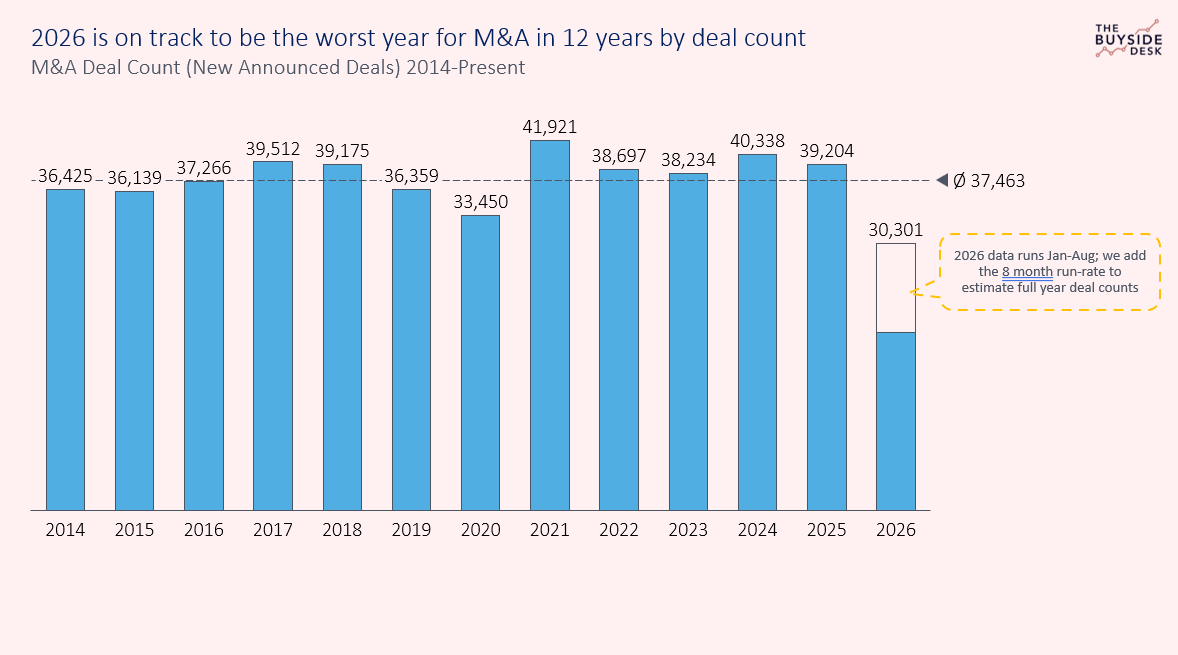
Monthly numbers show an even bleaker picture. Five of the seven weakest months since January 2014 have come between April and August 2026; the other two are April and May 2020. August’s preliminary M&A deal count of 1,931 is the lowest single month in the series, below even May 2020 (1,989). Every month since April has come in below 2,559 and is the lowest pre-2026 count outside the 2020 pandemic trough (February 2015).
At the current run-rate, 2026 would finish at roughly 30,000 deals, against a previous low of 33,450 in 2020 and at least 36,139 in every other year since 2014. Even if September to December matched 2025’s pace exactly, the full-year total would land at about 33,400, roughly level with the Covid pandemic lows of 2020.
War with Iran: when the floor gave way
2026 was already off to a weak start, with Jan and Feb showing modest declines between 6-8%. While not a great start, this level of fluctuation is normal in M&A deal making. The gap vs. 2025 levels widened significantly upon the outbreak of the US and Israeli war with Iran.
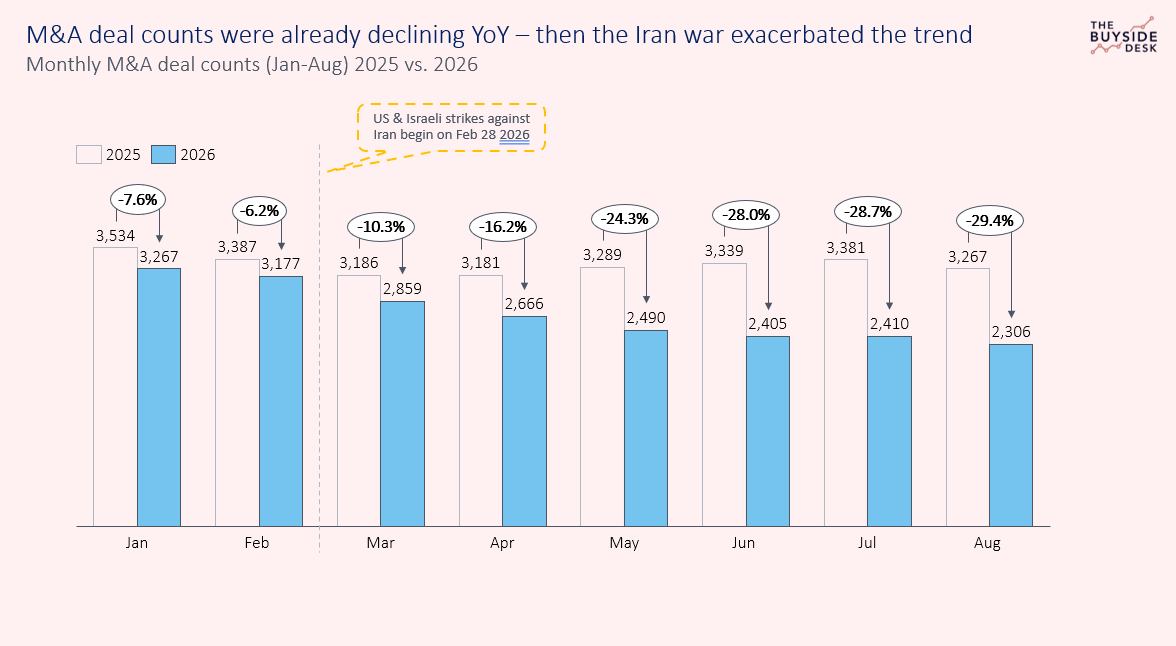
The timing lines up with the war with Iran. The US bombing campaign began on 28 February, choking off traffic through the Strait of Hormuz and pushing oil prices higher. A&O Shearman describes a first half in which the war, supply-chain disruption and sticky interest rates lengthened deal timelines, with processes delayed rather than abandoned. Delays show up in the count of announced deals straight away; the open question is how many of them come back.
The smaller the deal, the greater the pain
The collapse in volume sits alongside strength in value. In our data, total disclosed deal value for January–August is $1,779bn, up 2.4% on 2025, even though the number of deals fell by more than a fifth. The 55 deals above $5bn were worth $932bn — more than half of all disclosed value, and the second-highest January–August total for that band since 2014, after 2015.
That matches what the big advisers are seeing. PwC calls it a K-shaped market: deals above $5bn make up almost half of global value, double their share of two years ago, and stripping them out leaves value down 4%. BCG finds global value up 15% in the first eight months while deals below $1bn remain under their long-term norms. LSEG counts more than 28,000 deals in January–July, down 10%, even as value surged.
But The Buyside Desk disagrees with PwC’s characterization of a “K-shape” M&A market. The data simply does not support this conclusion as only deals over $5 billion are tracking above their long-term average. All other categories are declining. Its just that the smaller the deal size, the worse the situation gets. In the small-to-mid market (deals under $100 million), over 1/3rd of deal volume has evaporated this year.
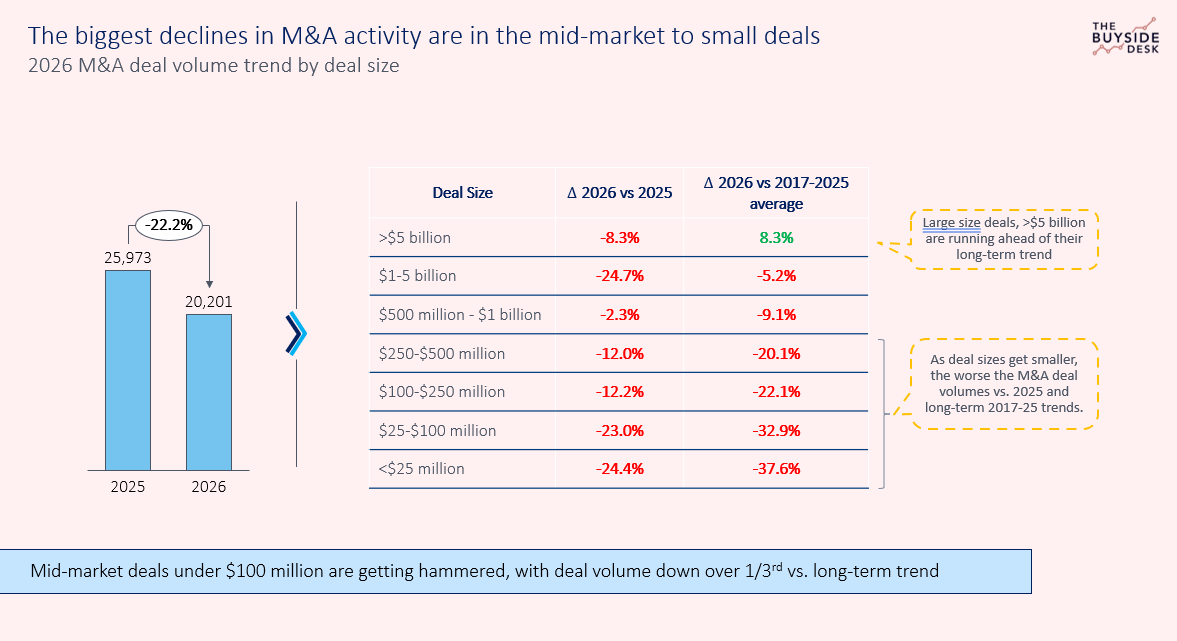
JPMorgan’s mid-year outlook makes tries to make the same point by implying that a “middle market rebound” has been slower because valuation gaps, execution risk and geopolitical uncertainty weigh more heavily on smaller companies. Once again, we disagree with JPMorgan’s characterization that there is any “mid-market rebound” underway. The data clearly shows 2026 has been getting worse month over month, with the worst performance in the mid-market segment (especially as deals get smaller).
What is driving this downturn?
The fall in M&A activity is broad and across the board. Our analysis shows it across virtually all industries we cover (more sector specific breakdowns to come in subsequent analysis). We speculate on a number of contributing factors, 3 of which are flagged below and none of which are likely to be fully resolved in the short-term.
War and an oil shock. The war with Iran is the clearest break point in 2026. US and Israeli strikes began on 28 February, choking off traffic through the Strait of Hormuz and pushing oil prices higher. Beyond the hit to confidence, that fed into inflation and interest-rate expectations. A&O Shearman describes a first half in which the war, supply-chain disruption and sticky rates lengthened deal timelines, with processes delayed rather than abandoned. Delays show up in announced-deal counts immediately.
Interest Rates that did not fall. Markets entered 2026 expecting cuts. Instead the Federal Reserve held its policy rate at 3.50–3.75% from December through August. By the July meeting, rising yields reflected expectations of higher, not lower, policy rates. On 16 September the FOMC then raised the target range to 3.75–4.00%. Cherry Bekaert names a Fed holding steady against a market that expected cuts as one of three forces that hit private equity in the second quarter.
Valuation gaps. When earnings visibility is poor, buyers and sellers stop agreeing on price. GlobalData cites macroeconomic uncertainty and valuation misalignments. PwC describes a middle market where neither side will bridge the gap. S&P Global says the same standoff slowed private equity exits in the first half.
AI disruption and the software reset. Almost every buyer now asks how AI will affect a target’s business. Bain’s private equity midyear report points to an AI-driven collapse in software valuations (“SaaSpocalypse”) with further scrutiny spreading to IT services, professional services, insurance brokerage and asset and wealth management. We will be deep-diving this topic in subsequent posts, as we question whether “SaaSpocalypse” is over-hyped.
What we are watching
The optimistic reading is that much of this year’s drop is postponement. We remain biased towards this interpretation. The earliest signals to watch for a turnaround are an end to hostilities in Iran and lower oil prices, the Fed’s next move on interest rates, and whether the year-end rush brings the mid-market back. December has been the busiest month in 11 of the last 12 years.
For now the numbers are clear. The headline value of M&A is booming. The number of companies actually changing hands is at its lowest in at least 12 years.
A quick note on methodology
The Buyside Desk leverages both proprietary and public sources to map out M&A transactions globally and derive insights. Our data set covers ~1 million M&A deals across sectors and geographies going back over 10 years. If interested in learning more, please fee free to message the author.
Public Sources leveraged for this content:
PwC – Global M&A industry trends: 2026 mid-year outlook
PwC – Global M&A trends in consumer markets: 2026 mid-year outlook
PwC – Private equity: US Deals 2026 midyear outlook
BCG – The 2026 M&A Report: In Search of a Wider Recovery
BCG – 2026 M&A Trends Across Key Global Regions
LSEG – Global M&A update: a record-breaking market that’s becoming increasingly concentrated
GlobalData – Global deal activity falls 4% YoY during January–August 2026
A&O Shearman – M&A in 2026: strategic focus, geopolitical pressures and regulatory shifts
A&O Shearman – Middle Eastern dealmaking endures despite regional instability
Ropes & Gray – Dealmaker’s Digest, August 2026
J.P. Morgan – 2026 Global M&A Mid-Year Outlook
PitchBook – 2026 US Private Equity Outlook: Midyear Update
Cherry Bekaert – Private Equity Mid-year 2026 Report
S&P Global Market Intelligence – Pace of private equity exits slows in H1 2026
Yahoo Finance – Private equity is struggling with exits, even as the AI deal boom takes over Wall Street
Private Capital Global – What Bain’s midyear report tells us about where the market really stands
American Banker – War in Middle East may press pause on bank deal boom
Yahoo Finance – US holds interest rates as Iran war triggers inflation fears
Federal Reserve – Minutes of the FOMC, 28–29 July 2026
Federal Reserve – FOMC statement, 16 September 2026
HMT LLP – What impact is the US/Israeli war in the Middle East likely to have on M&A in the UK’s mid-market?
Wall Street Horizon – Fewer deals, bigger stakes