

Getting the buy cycles right in the semicaps space can be a lucrative challenge. Having been through a few of these cycles over the years, we have learned to be patient with these names. Lam Research LRCX 0.00%↑ has been one such name. We wrote extensively about this company and even published a 42-page deep dive when the stock was $347 (our valuation model is also available). In brief, we thought $347 was overpriced and put our buy price at $200. Some thought this was an overly aggressive call as our price was ~40% lower than the market price at the time. But we’ve been through semicap cycles before and price swings such as these are a recurring pattern.
At time of writing, LRCX is currently trading at roughly $203 per share which is close enough to our price target of $200 that we now upgrade LRCX to “buy”. Nothing at Lam has changed our analysis on their growth prospects over time. Rather, we think the sell-off has been sector-wide as the whole chip-equipment group has sold off. Other names in this space are also attractive, and we are hoping to publish further deep dives shortly to support this assertion.
Lam Research (LRCX) business is still on track
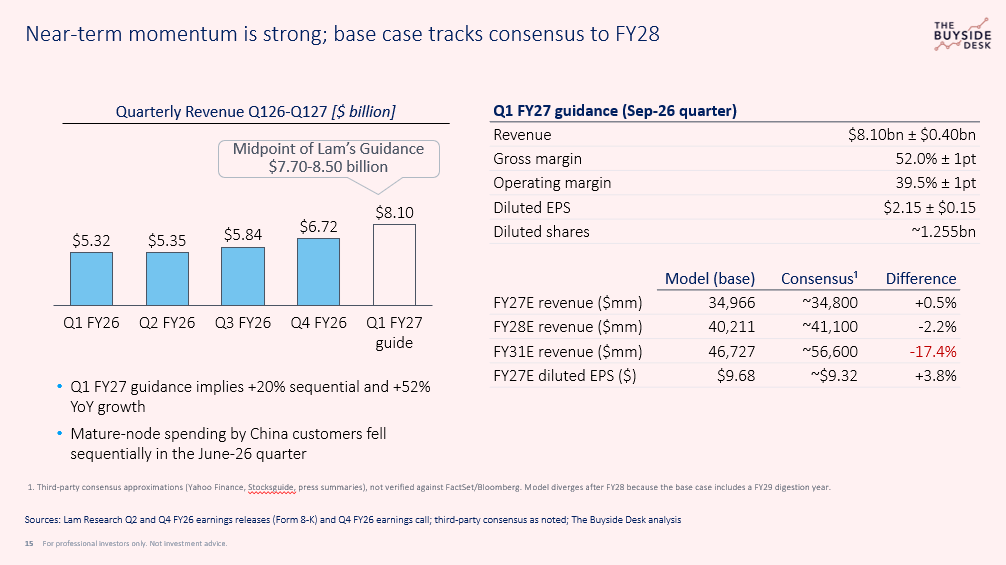
Lam’s September quarter, reported on 21 October, was a record. According to press coverage of the release, revenue rose 54% year on year to $8.22bn, gross margin hit an all-time high of 52.4%, and free cash flow was a record $3.2bn. Memory systems revenue also hit a record.
Guidance for the December quarter is $8.6bn, plus or minus $0.4bn. That keeps Lam on track for our base case of $35.0bn in FY27 revenue. Management also expects wafer-fab equipment spending to exceed $200bn in 2027, up about 30% on 2026, though supply constraints may cap how much Lam can ship.
In short, the numbers we built our valuation on are holding.
What today’s price implies, and why it is a “Buy”
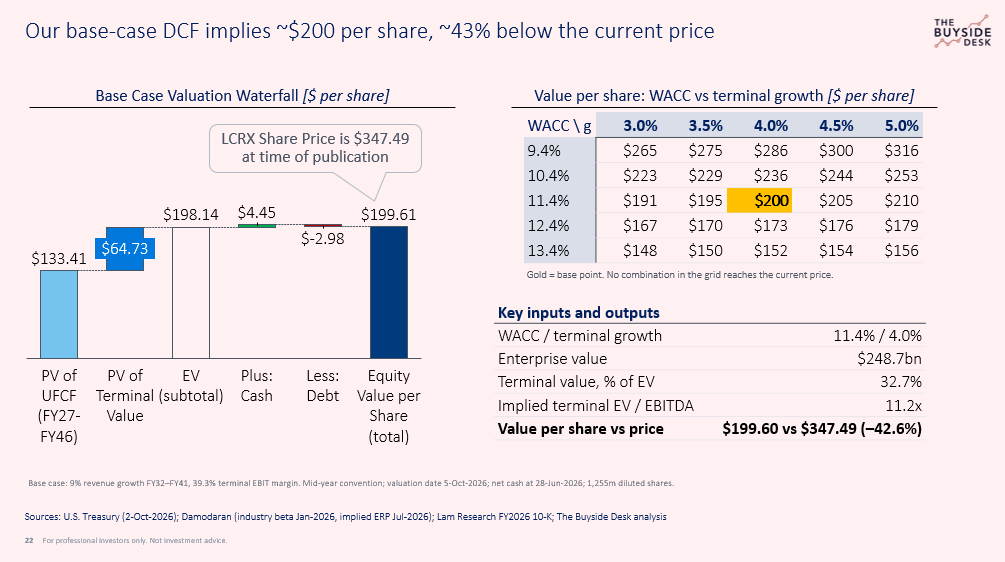
Our base case DCF valuation put LRCX at $200 per share based on “through the cycle” growth rates. The challenge with valuing cyclical semicap stocks like LRCX is that revenue growth assumptions can get flattered depending on when you take your base years. Adjusting for “through cycle” growth allows a more sober analysis even though the end result tends to be more conservative. We saw this when we wrote our $200 buy target while LRCX traded at $347 and the market was, we thought, overly optimistic about growth prospects.
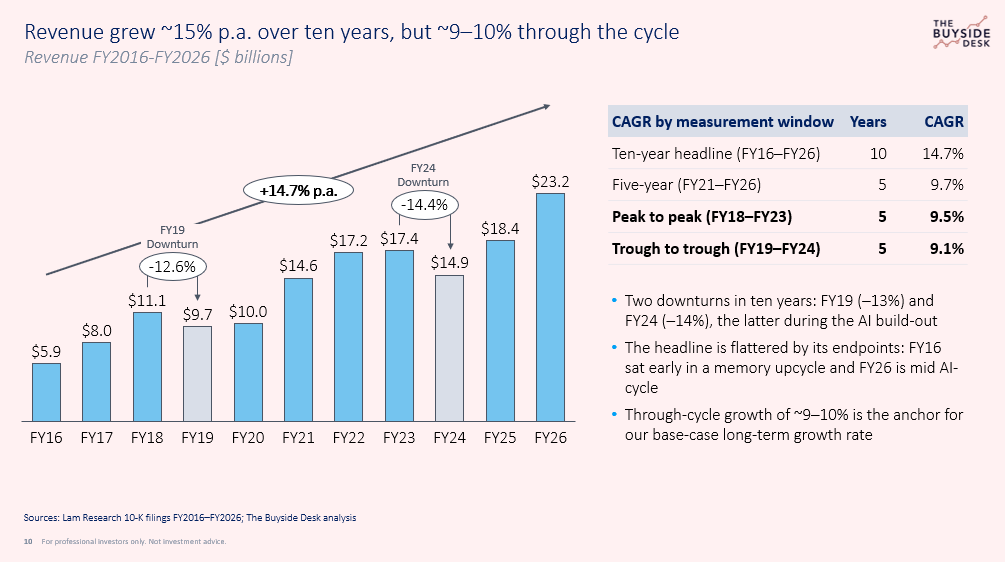
At today’s price, the market is now pricing in a more reasonable ~9.5% growth rate over the next decade. We think this is both reasonable and possibly conservative given the demand drivers for Lam’s business.
But it is not yet a “pound the table” buy…yet
At $200, investors are getting a terrific business at a fair price. Historically, investors getting into this business at comparable levels in the past have enjoyed decent returns. However, we also note that for cyclical businesses like Lam, markets can swing too far into pessimism just as they swing in the opposite direction. At $180 or below, the margin of safety begins to expand in investors favor and we would be adding more aggressively at that point.
We will continue to follow and update on Lam Research…
Please subscribe for further updates. Also, please see our full 42-page deep dive report and valuation model (available for free) covering Lam Research. This update was brief because we did the deed dive work already. Deep dive research allows us to set targets and pull triggers with confidence. If you’re reading this, you probably like that idea. And that is a good reason to subscribe.
The discipline here is the interesting part — you called $347 overpriced, set $200 as the buy price when that looked about 40% too low, and then actually bought the dip instead of moving the goalposts. The through-cycle question is whether AI compute demand holds up long enough for that ~9.5% growth to be the conservative case. One data point on that side: Nebius, the leftovers of the Yandex split after the Russian business was sold for $5.4B, signed a $17.4B Microsoft deal within about a year. That's not a chip order, it's a customer locking in compute — which is ultimately what fills Lam's order book. What would break the thesis for you — a memory downturn, or fabs just pausing capex?