

When a company spins off or sells a portion of its business in a carve-out, it’s not just a clean break. The process involves untangling shared operations, systems, and resources. A Transitional Service Agreement (TSA) is a critical tool that ensures the carved-out entity can operate smoothly while building its own infrastructure.
However, they should not be considered a long-term solution. The most important word is “Transitional”. These agreements should be temporary, and a guiding principle of carve-outs should be to avoid TSA’s whenever possible. Where they can not be avoided, they should be as brief as possible. In this way, they enable (rather than delaying) the carved-out business to become fully independent. Below are the top-5 questions about TSA’s for those involved in a carve-out situation.
What is a Transitional Service Agreement (TSA) in a Carve-Out?
A Transitional Service Agreement is a temporary contract between the parent company and the carved-out entity, detailing services the parent will provide post-separation to ensure operational continuity. These services, like IT, HR, or logistics, typically last 6–24 months while the new entity builds its own systems. TSAs are vital because carve-outs often leave the new entity dependent on the parent’s infrastructure, and without a TSA, operations could stall. A major objective of all carve-out projects is to ensure “Day-1 Readiness” of the carved-out business. That means the new business should be able to run as independently as possible on Day-1 after the carve-out is completed.
All TSA agreements should specifically detail service scope, duration, costs, and performance standards to prevent disputes and ensure a smooth transition. When the carve-out is in connection with a divestiture (i.e. the carved-out business is being acquired by a new owner), it is the new owner that should determine whether a TSA is truly needed.
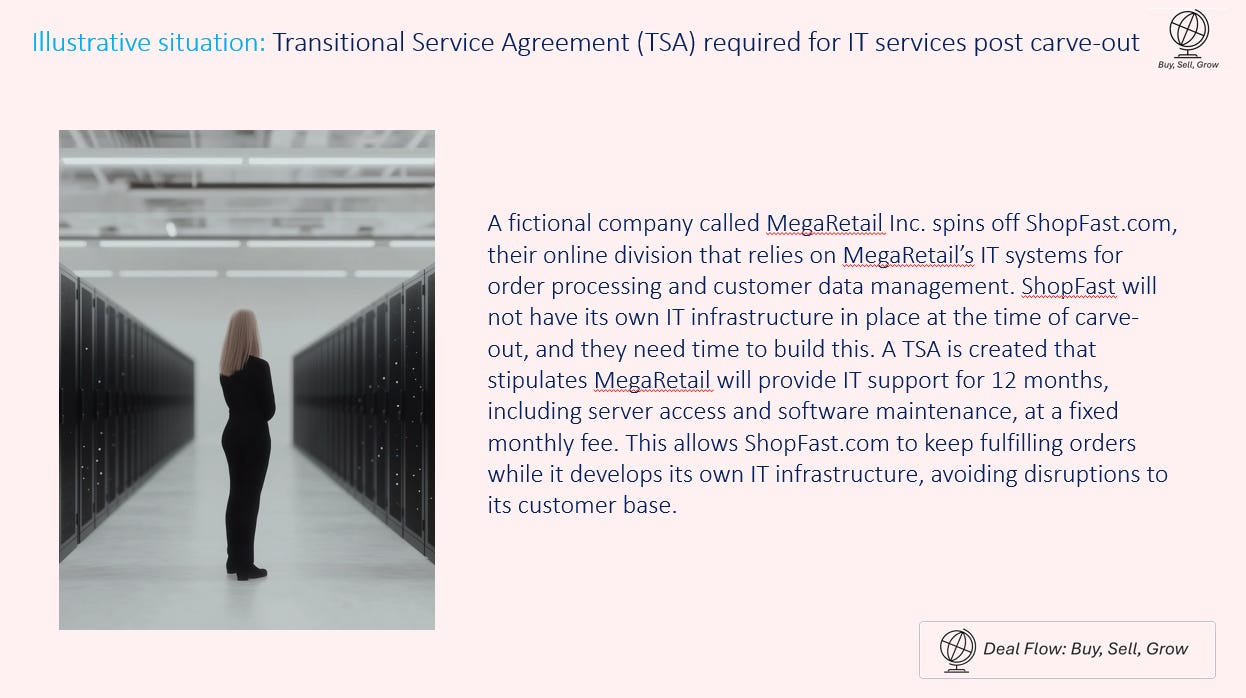
The above example covers IT services post carve-out. But the same principle applies to a range of possible services. For instance, logistics, warehousing, marketing, payroll systems etc. These are all common areas for TSA’s. In the case of a company acquiring the carved-out business, they should ask which processes can be absorbed into their existing systems and processes. Good post-merger integration programs can mitigate the need for longer TSA’s.
What Are the Key Components of a TSA?
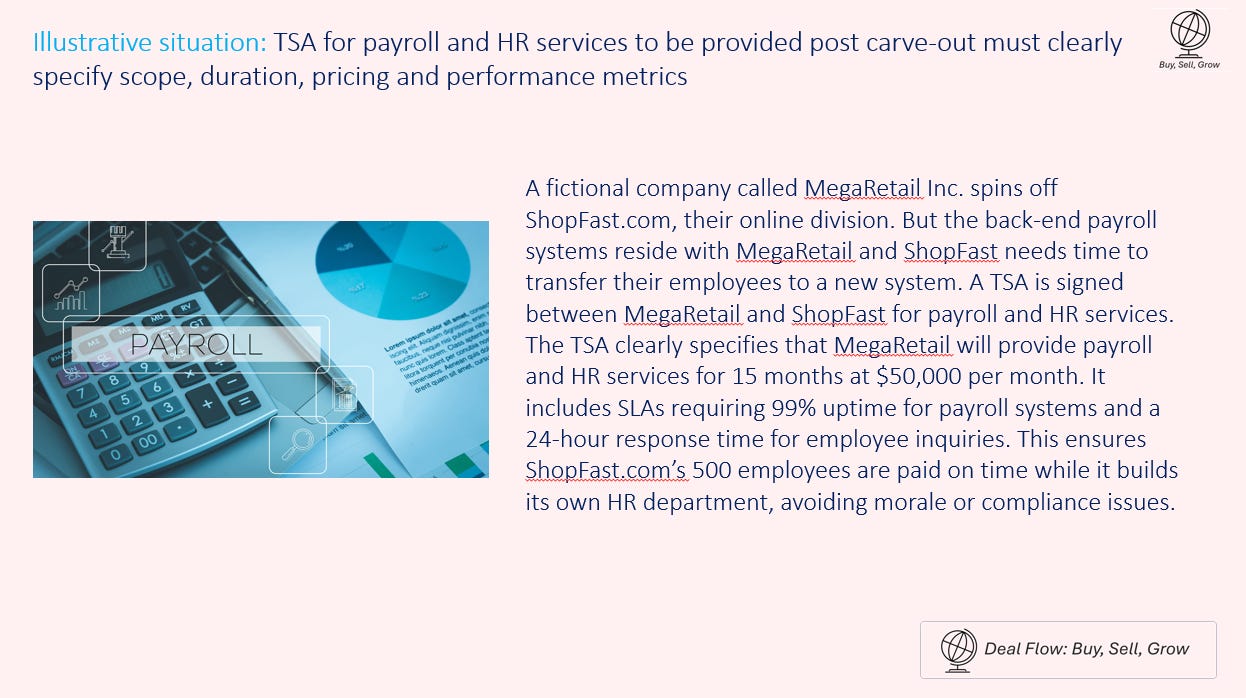
A TSA typically includes four key components: scope of services, duration, pricing, and performance metrics. The scope defines what services the parent will provide, such as IT or accounting support. Duration sets the timeline, often with extension options. Pricing outlines costs, which may be fixed or variable, ensuring transparency. Performance metrics, like service-level agreements (SLAs), hold the parent accountable for quality and timeliness [Note: I’ll cover SLA’s in a subsequent article]. These components create a clear roadmap, preventing misunderstandings and ensuring both parties know their responsibilities, like a detailed playbook for a smooth handoff.
What Are the Challenges of Implementing a TSA?
Implementing a TSA can be challenging due to misaligned incentives, unclear terms, or operational complexities. The parent may prioritize its own operations, leading to subpar service for the new entity. Vague terms can cause disputes over costs or quality, while complex operations may strain the parent’s resources. To address these, both parties must negotiate clear terms, align incentives, and monitor performance closely, like refereeing a game to ensure fair play. And this is before the most crucial challenge of all: time. It takes time to negotiate a TSA. Think of the specificity involved and stakeholder alignment needed. If the carve-out is in connection with an M&A transaction then the TSA terms could even impact the valuation and price being paid. If the parent company is not providing sufficient flexibility on TSA’s, the acquiring company may abandon the deal entirely. This is why it is critical to have an advisor that has done this before. They’ll understand the time needed, stakeholders required and address potential risks early on while they can still be handled “easily”.
How Long Do TSAs Typically Last, and Can They Be Extended?
TSAs typically last 6–24 months, depending on the complexity of the carve-out and the new entity’s readiness to operate independently. The duration is set to balance the need for support with the goal of the new entity becoming self-sufficient. However, as a general principle they should be for the minimum required duration so as not to delay true “Day-1 readiness”. For complex systems and services, it is often the case that TSA’s have to be extended. But beware that any negotiation for an extension will happen after the carve-out or M&A transaction has closed. The former parent company may be unsympathetic to potential disruptions because the new company is not ready by the end of the initial TSA. That is why extensions often come with renegotiated terms and considerably higher costs. Clear exit strategies and milestones in the TSA help both parties plan for a smooth end to the agreement, like setting a finish line for a relay race.
TSA’s are inevitable for any complex carve-out, providing a lifeline for the new entity as it gains independence. For companies navigating carve-outs, a well-crafted TSA is like a bridge over turbulent waters—essential for reaching the other side intact.
The most important message I can give for those tasked with executing a carve-out, or businesses contemplating a carve-out is this: Carve-outs are hard, and you need an advisor that has done it before. The vast majority of companies have no internal expertise with this kind of project. This is not their fault, carve-outs are highly specialized activities and businesses don’t do them very often.
I am available for interim carve-out advisory engagements. If interested, please contact me at stephen.mcnamara@onetoonecf.com for an introductory discussion.