

In 1997, Hong Kong was formally returned to the People’s Republic of China (PRC) under the “One Country, Two Systems” framework. This arrangement allowed Hong Kong to retain key aspects of its sovereignty for 50 years, including its own currency. However, what is often overlooked is the considerable market volatility, panic, and currency crisis that preceded the handover agreement.
As we enter 2025, only 22 years remain until “One Country, Two Systems” expires and transitions to “One Country, One System.” It’s only a matter of time before investors begin betting against the Hong Kong Dollar (HKD) and capital starts to flee the region.
The HKD: A History of Stability Born from Crisis
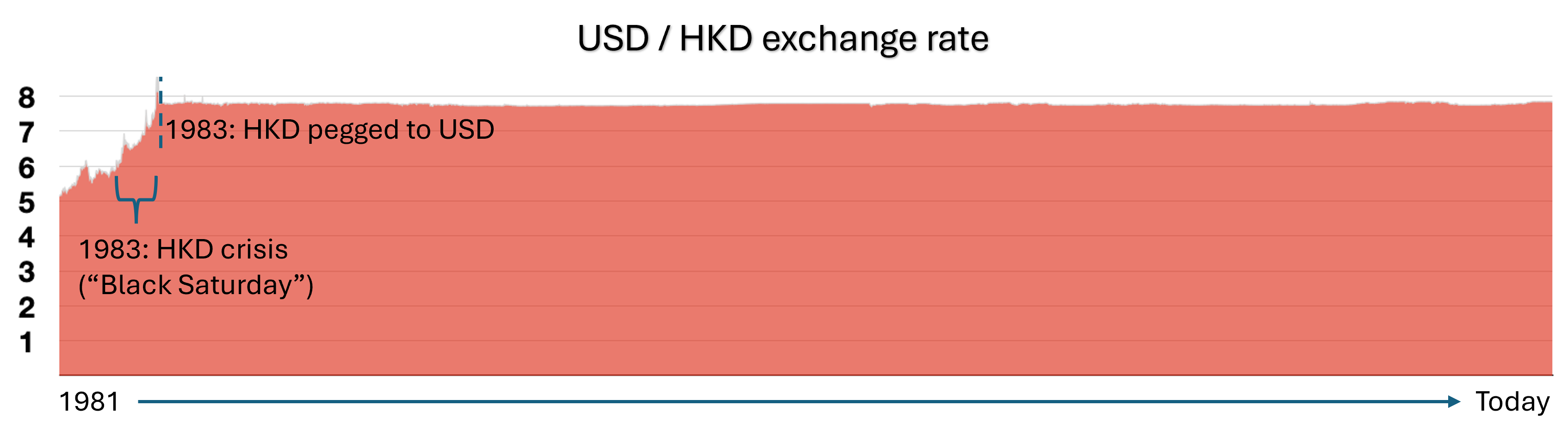
The Hong Kong Dollar has been pegged to the US Dollar (USD) at a fixed exchange rate for over 40 years—a remarkable achievement. This peg was introduced in response to the anxiety and panic surrounding the 1997 handover to China.
Between 1974 and 1983, the HKD operated under a floating currency regime, like most major currencies. However, the handover negotiations, conducted behind closed doors and without public consultation, led to rampant speculation. When it became clear that British sovereignty would not be extended, public speculation turned into panic.
In September 1983, the HKD’s value plummeted over 15% in two days. Merchants began repricing goods in USD, store shelves emptied, and there was a run on essential items. This culminated in the infamous “Black Saturday” on September 24, 1983. Within three weeks, Hong Kong pegged its currency to the USD to restore stability—a peg that has remained intact ever since.
The Peg: Stability with an Expiry Date
The linked exchange rate system underpinning the peg ensures that three chartered Hong Kong banks can issue HKD only if they hold an equivalent amount of USD. This mechanism theoretically eliminates the possibility of a run on the HKD. However, a deeper question looms: if every Hong Kong resident converted their HKD into USD, how much would the HKD truly be worth?
This is not just a theoretical concern. In 22 years, the HKD will cease to exist, replaced by the Chinese Renminbi (RMB). While details are unclear, the transition will likely involve a shift in the peg from the USD to the RMB, potentially through a phased process.
A Gradual Shift to the RMB: Theory vs. Reality
One proposed approach is to peg the HKD to a basket of currencies, including the USD and RMB. Over time, the weighting would shift toward the RMB, stabilizing the HKD around a peg to the Chinese currency. This would be followed by a dual-currency circulation period, during which both RMB and HKD are used for transactions. For comparison, Germany’s adoption of the Euro involved a 3-year dual circulation period during which the Euro was introduced. If we assume a 10-year gradual change in HKD peg and a 3-year dual circulation period, then this process would start in less than a decade. However, while plausible in theory, this scenario is fraught with challenges.
When Germany adopted the Euro, the Euro was perceived as a stabilizing force and they were joining a strengthening Eurozone. In contrast, Hong Kong is likely to be integrated into a Chinese economy under significant pressure. The recent performance RMB does not provide confidence for the future. Over the past two years, the RMB has declined 13% against the USD (and HKD) and is at its weakest point in a decade—despite strict capital controls. Historical parallels, such as Japan’s “lost decades,” suggest that prolonged economic stagnation could lead to even greater devaluation. For HKD holders, pegging to the RMB may appear to be a recipe for wealth destruction.
The Looming Question: Capital Flight
With only 22 years remaining until Hong Kong transitions to 'One Country, One System,' the stability of the HKD faces its greatest test. Historical parallels, both in Hong Kong’s past and in international currency transitions, suggest that public anxiety and capital flight could emerge much sooner than expected. The HKD's fate hinges on investor confidence—confidence that may falter long before 2047