

In 2025, more than half of U.S. operating-company IPOs came from issuers headquartered abroad. In the first nine months of 2026, that share collapsed to 14%. The Asian micro-cap pipeline has been switched off, and blank-cheque companies have taken its place. The shift is a regulatory story, but it is also a positioning one. Here is what happened, why it matters, and how investors can act on it.
The headline numbers
For years the U.S. IPO tape quietly depended on a stream of very small foreign issuers—mostly Cayman Islands holding companies for businesses in Hong Kong, mainland China, Singapore, and Malaysia—raising single-digit millions on the Nasdaq Capital Market. In 2025 that stream became a flood. In 2026 it has all but dried up.
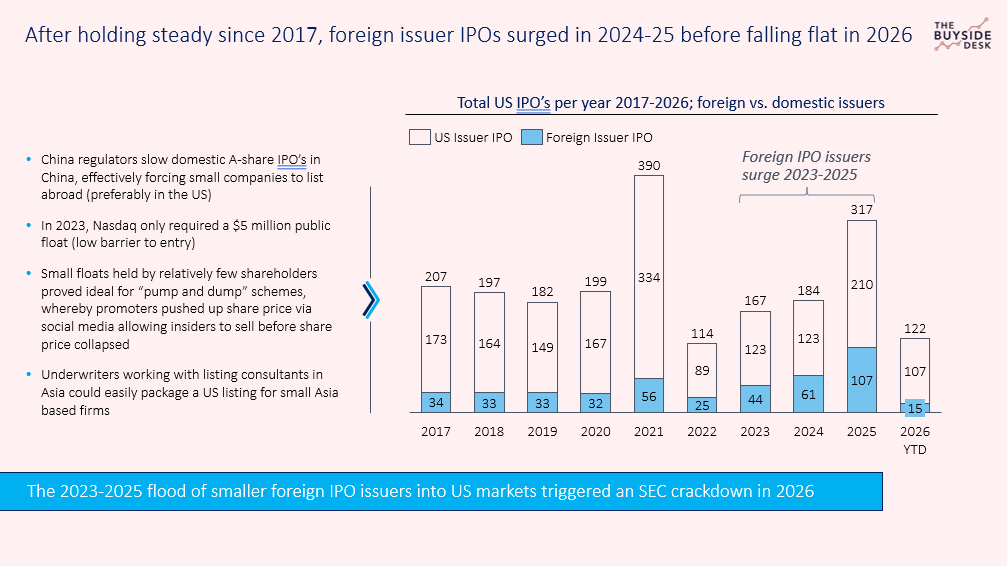
The numbers are stark. One hundred and seven foreign companies completed IPOs on U.S. exchanges in 2025, the most in at least a decade and 51% of the 210 operating-company IPOs that year. In January–September 2026, just 15 have listed, out of 107 total (14%). In the same nine months of 2025 there were 89 foreign IPOs out of 165 (54%). That is an 83% drop.
Why 2025 was a flood
The surge was not a sudden burst of demand for Asian small-caps. Three forces pushed in the same direction at once.
Few options in China. In mainland China, regulators slowed domestic A-share IPOs from August 2023, while the overseas-listing filing rules in force since March 2023 gave small companies an approved route abroad. Deflation and slowing growth added pressure on private firms to raise money offshore.
An easy door in New York. The Nasdaq Capital Market required only about US$5m of public float. A small group of U.S. underwriters, working with listing consultants in Asia, packaged operating businesses into Cayman Islands holding companies and took them public for single-digit millions. A US became a product that could simply be bought.
Money in the trading, not the company. Tiny floats held by a few connected shareholders are ideal for “pump-and-dump” schemes, in which a share price is pushed up through social-media promotion before insiders sell. For the promoters, the listing itself was the profit regardless of the business quality or impact on retail shareholders.
This understandably triggered crackdown in the US. Regulators had been warning since 2022, when FINRA flagged that most suspect small-cap IPOs involved issuers with operations in China and other foreign countries. In 2024 Nasdaq began questioning who the pre-IPO shareholders in small Chinese and Hong Kong deals really were. The record volume of 2025 pushed it further. Nasdaq’s own analysis found that 143 of 151 China-based companies listed between August 2022 and April 2025 would not have met its stricter rules. Since September 2025 the SEC has suspended trading in 14 foreign issuers over suspected social-media manipulation.
For investors, the lesson is clear: in this cohort the reason for listing was often the trading rather than the business. That is worth remembering when similar companies turn up in Hong Kong or in SPAC deals.
The drop is almost entirely Asian micro-caps
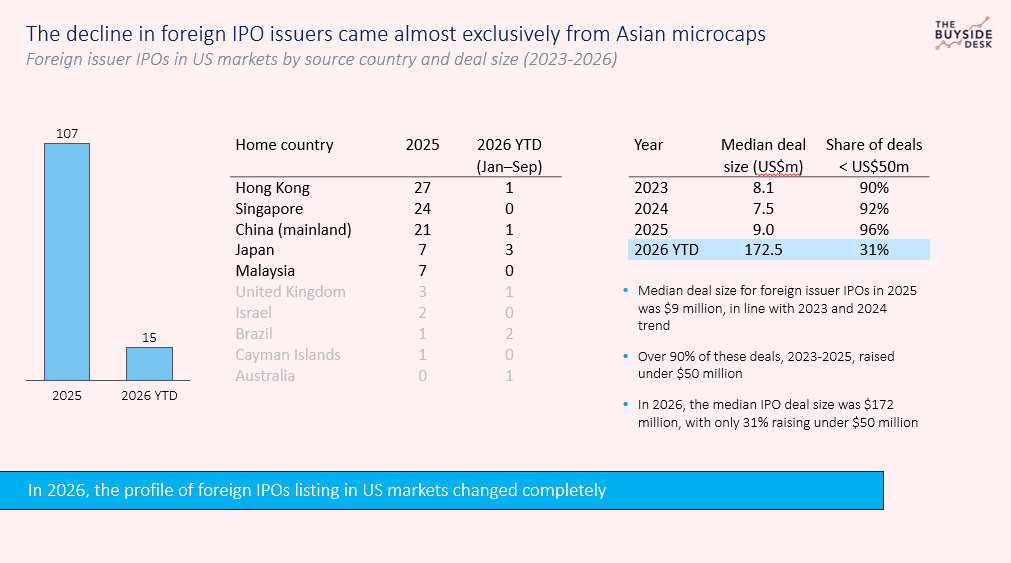
The decline is concentrated almost entirely in Asian issuers. The five Asian origin markets that dominated 2025 (China, Hong Kong, Singapore, Japan, and Malaysia) went from 86 U.S. IPOs in 2025 to 5 in January–September 2026. Singapore and Malaysia, which supplied 31 U.S. listings between them last year, have produced none in 2026. Hong Kong and mainland China, which together supplied 48, have produced two.
The 2025 cohort was overwhelmingly tiny. The median foreign IPO on a U.S. exchange raised just US$9.0m, and 96% raised less than US$50m. The handful of foreign issuers that have listed in 2026 are a different kind of company: the median deal is US$172.5m, and fewer than a third raised under US$50m.
Timing: the cliff lines up with US regulator moves
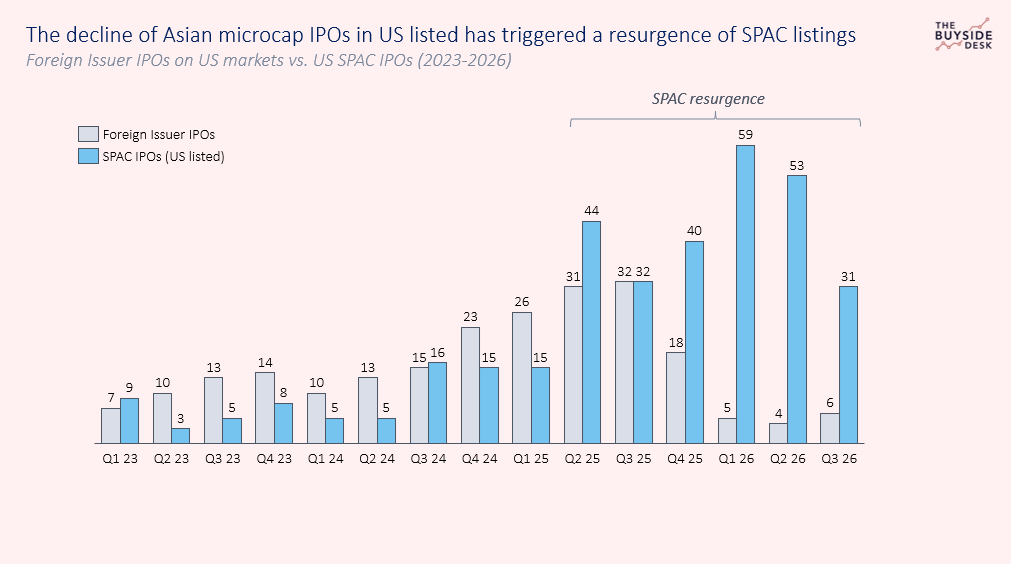
The quarterly numbers show exactly when the pipeline broke. Foreign-issuer IPOs on U.S. exchanges peaked at 31–32 per quarter in Q2 and Q3 2025. They fell to 18 in Q4 2025 and then to 5, 4, and 6 in the first three quarters of 2026. The timing is not coincidental, US regulators were busy.
September 3rd 2025: Nasdaq’s listing-standard proposal. Nasdaq submitted proposals to the SEC to tighten both its initial and continued listing standards. There were 4 main pillars of this initiative:
New listings under the net income standard would need a public float worth at least US$15m, up from US$5m
Companies principally operating in China would need to raise at least US$25m in public offering proceeds (keep in mind that the median deal size in 2025 was $9 million, so this impacted a majority of Chinese listings)
Companies with a listing deficiency and a market value of listed securities below US$5m would face accelerated suspension and delisting
Companies already in the listing process would get 30 days to complete it under the old standards.
Nasdaq presented the package as a liquidity and market-integrity measure: higher float and offering minimums give public investors a deeper initial pool of tradable shares. For the China rule, Nasdaq argued that the smaller offering sizes, lower public floats, and limited investor base of China-based companies leave their securities more exposed to manipulation. Their evidence to back up this claim was particularly striking: from between Aug 2022-Apr 2025, ~70% of Nasdaq’s market-manipulation referrals to the SEC or FINRA involved Chinese companies, although those companies were under 10% of Nasdaq listings.
September 5th 2025: SEC’s Cross-Border Task Force. Only 2 days after Nasdaq’s new listing standard proposal, the SEC’s Division of Enforcement formed a task force to investigate fraud involving foreign-based companies accessing U.S. markets. Its initial priority was targeting “pump-and-dump” schemes prevalent in the microcap space. They also targeted the IPO deal gatekeepers, including the auditors and underwriters who bring these issuers to market.
Taken together, Nasdaq’s rules raised the bar for entry while the SEC task force raised the cost of misconduct, both for issuers and for the firms that bring them to market. The focus on gatekeepers changes the economics of the channel. A micro-cap IPO earns its underwriter and auditor small fees, but it now carries real enforcement risk. This pressure applies whatever the issuer’s jurisdiction, which helps explain why Singapore and Malaysia dried up too.
SEC approvals (December 2025 and May 2026). On 18 December 2025 the SEC approved the US$15m public-float rule (SR-NASDAQ-2025-068). On 14 May 2026 it approved Nasdaq Rule 5210(l) (SR-NASDAQ-2025-069). That rule requires China-based issuers, including those in Hong Kong and Macau, to raise at least US$25m in gross proceeds through a firm-commitment offering, as issuers’ later F-1 filings spell out.
These approvals rendered the rules binding. By the time of the approvals, the pipeline had already emptied: foreign-issuer IPOs were down to 5 in Q1 2026, before the China rule was approved in May. The approvals locked in the new floor rather than creating it. The firm-commitment requirement also matters. The underwriter must take the shares onto its own books rather than sell them on a best-efforts basis, which raises the bar for the smallest deals.
A US$25m minimum offering size is almost three times the US$9m median deal that defined the 2025 foreign cohort, so most of last year’s pipeline would not qualify under the new rule.
Two further points stand out.
The deals stopped before the rule was final. The collapse in Q4 2025 and Q1 2026 came well before the May 2026 approval of the China rule. Proposed rules, the public-float requirement, and heightened enforcement scrutiny of underwriters and auditors appear to have been enough to stall the pipeline. Nasdaq also retains discretionary authority over initial listings.
It wasn’t only China and Hong Kong. Singapore and Malaysia, which are not covered by the China-specific rule, also went to zero. The US$15m public-float threshold and the SEC’s gatekeeper focus apply regardless of jurisdiction. That points to a market-wide chill on the sub-US$25m foreign listing model, even if the exact trigger differs from one market to the next.
SPACs fill the gap
As foreign micro-caps left the U.S. tape, blank-cheque SPAC companies surged back in to fill the void. U.S.-listed SPAC IPOs rose from 41 in 2024 to 131 in 2025, and there have already been 143 in January–September 2026. SPACs now account for 57% of all U.S. listings, above the 2020 level and second only to 2021 (60%). Quarterly SPAC counts (59 in Q1 2026, 53 in Q2) are more than ten times the number of foreign operating-company IPOs.
Operating-company IPOs on U.S. exchanges fell from 165 to 107 (–35%) in January–September 2026. But foreign issuers alone account for 74 fewer deals, more than the entire decline. Domestic listings actually rose, from roughly 76 to 92. In other words, the drop in U.S. IPO counts is a foreign micro-cap story, not a domestic one. Value tells a similar story: excluding SpaceX, U.S. IPO proceeds were up about 60% year on year. The foreign issuers still coming to New York are larger, institutionally marketed deals such as PayPay, Doncasters, and Braiin.
Five implications for investors (not investment advice)
What Each idea below sets out the setup, how to use it, the risks, and what would prove it wrong. None is a recommendation to buy or sell a particular security.
Investors should consider exiting their holdings of foreign microcaps, particularly the 2025 IPO cohort, given their heightened risk of delisting
Last year’s 107 foreign listings were overwhelmingly micro-caps and they now trade under stricter rules, including Nasdaq’s accelerated suspension and delisting process for deficient companies with a market value below US$5m.
Avoid the temptation to short-sell these firms. These firms tend to have thinly traded floats that can spike violently. Short sellers beware.
Use the SPAC glut. U.S. SPAC IPOs went from 41 in 2024 to 131 in 2025, and there have been 143 in the first nine months of 2026. Each vehicle has a fixed deadline to find a merger target, and the pool of good targets has not grown nearly as fast. Some foreign companies that can no longer clear the IPO thresholds will try the SPAC route instead, but the merged company still has to meet the exchange’s listing requirements, and the SEC’s gatekeeper focus covers these deals too.
Risk takers can follow the issuers to Hong Kong. For Asian small-caps, the listings have moved rather than vanished. IPOs in Hong Kong are up about 40% year on year in January–September 2026, and 96% of them are by companies based outside Hong Kong, mostly in mainland China. But buyer beware: the features that worried U.S. regulators (small floats, concentrated holders, limited investor bases) travel with the issuer. Apply the same float and liquidity screens in Hong Kong that you would have applied in New York. Hong Kong IPO volumes are also cyclical and closely tied to mainland sentiment.
IPO opportunities may have improved for US investors. Operating-company IPOs on U.S. exchanges fell 35% in January–September 2026, but foreign issuers account for more than the entire decline. Domestic listings actually rose, from roughly 76 to 92. Anyone using IPO counts as a gauge of risk appetite should strip out foreign micro-caps, which flattered 2025 and make 2026 look weaker than it is.
The U.S. market has closed the door on the smallest foreign listings. The companies have not disappeared; the activity has moved. Investors who track the regulatory signals, the venue shift, and the quality of what remains on the U.S. tape will be better positioned for what comes next.