

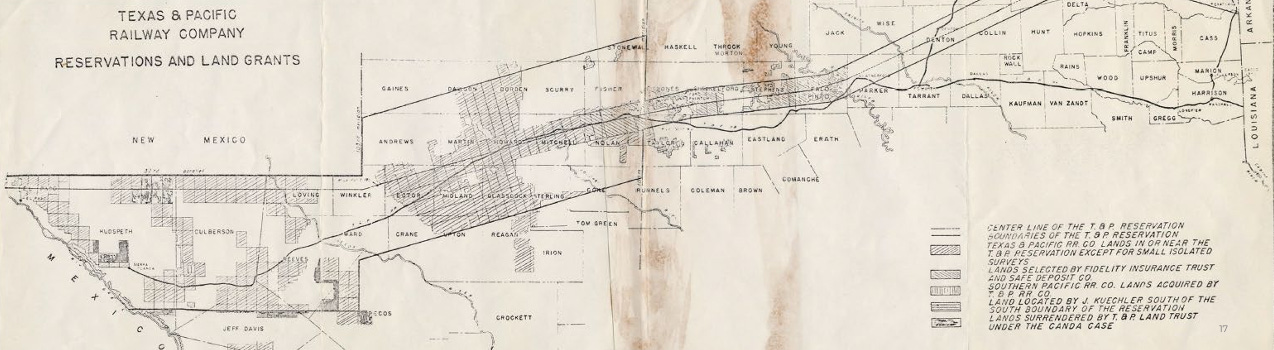
Texas Pacific Land Corp. ($TPL) stands as one of the most intriguing and unconventional success stories in American business. Tracing its origins back to the 19th century, TPL emerged from the ashes of the Texas and Pacific Railway’s bankruptcy, inheriting vast swathes of undeveloped land and mineral rights that nobody foresaw would become extraordinarily valuable. Over the decades, what began as an effort to liquidate land assets transformed into a thriving enterprise, capitalizing on the rich natural resources beneath its holdings.
The numbers alone highlight TPL’s remarkable ascent. In 2024, the company’s value skyrocketed by an astounding 185%. Over the past five years, it delivered a return of 435%, while its ten-year performance stands at an eye-popping 3,750%. These are growth figures more commonly associated with disruptive tech startups, not a century-old entity originally tasked with selling land to pay off creditors. Yet, TPL has defied expectations at every turn, proving itself a paragon of resilience and adaptability.
This report delves into the historical evolution of TPL, examining its journey from a relic of railroad history to a major player in land and mineral rights management. It provides an in-depth exploration of the company’s unique business model, financial performance, and long-term growth prospects. Whether you’re an investor or simply curious about one of America’s most fascinating corporate transformations, this analysis offers a comprehensive overview of TPL’s legacy and future potential.
The story begins with a bankrupt railroad…
The Texas and Pacific Railroad Company was chartered by federal act in 1871, with the Texas legislature granting permissions to consolidate several railroad companies and expand the rail network. Rail was the primary mode of transportation during a construction boom, facilitating commerce and population growth across the vast American West. The model of granting land to railroad companies for building infrastructure was a bold strategy aimed at accelerating development while offsetting costs. By the late 19th century, these grants were among the largest land giveaways in U.S. history, and the railroads became both transportation enterprises and some of the largest landholders in the nation.
However, the optimism was short-lived. In 1888, a series of natural disasters—including a devastating flood in Louisiana and crop failures from a Texas drought—pushed the Texas and Pacific Railroad into bankruptcy. During bankruptcy proceedings, the courts converted more than 3.5 million acres of the company’s land holdings into a new entity, the Texas Pacific Land Trust. Bondholders received shares in this trust, and its trustees were tasked with selling the land to repay debts. And so began one of the longest bankruptcy liquidations in American history. Interestingly, the trust persisted for decades, as demand for this remote and undeveloped land was very slow to materialize.
The slow pace of land sales, and general lack of interest in the land portfolio, frustrated the Texas Pacific Railway bondholders, now shareholders in the land trust. Their shares in the trust proved illiquid and hard to sell. But beneath the surface lay some value. At the time the trust was established in the late 19th century, mineral rights were not widely understood – and they came attached to the land rights [in contrast to today, where surface rights and mineral rights are commonly separated]. It seemed the shareholders, long waiting for an opportunity to cash-out, had finally caught a break. The Texas Oil Boom of the 1920’s (also known as “The Gusher Years”) converged with the stock market boom of the “roaring twenties”. There was significant public enthusiasm for new company listings, valuations were rich – and the mineral rights were considered a potential “hidden treasure” after oil was discovered on the land holdings. In 1927, nearly four decades after its creation and with much of the trust’s land still unsold, the shares began trading on the New York Stock Exchange. The land portfolio remained mostly barren and undeveloped, but the stock market mania allowed some long-term shareholders to find an attractive exit. [Note: the stock market crashed in 1929 – so investors that sold at, or just after, the IPO may have had very good timing]
The Texas Oil Boom ended with the Great Depression. But oil exploration and development took on new significance during and after World War II. In the 1950’s, the hunt for oil on TPL’s land was back in earnest. In 1954, TPL established the TXL Oil Corporation to capitalize on its mineral assets, formalizing its role in the oil industry. The trust slowly began to shift focus towards the value of its mineral assets. As before, this evolution moved very slowly. In the 1970s, the Arab Oil Embargo accelerated domestic production and significantly boosted TPL’s royalty income. In the 1980s (now almost a century after the original bankruptcy), TPL made a big strategic pivot: they would emphasize shareholder value, leveraging oil revenues to repurchase shares and reduce outstanding stock. The focus on land-sales, despite it still being the “official purpose” of the Trust, was being deprioritized (though they were still selling down land on a regular basis).
TPL remained a relatively boring, but stable, business until the 2000’s. A new technology: horizontal drilling promised to unlock vast oil resources in the Permian and Delaware Basins of the United States. TPL found itself sitting on the land and mineral rights for a big part of one of the world’s richest oil fields. The boom was on – and this one made the 1920’s “Gusher Years” look miniscule by comparison.
In 2021, TPL transformed from a Trust to a Corporation formally eliminating its mandate to liquidate its land holdings. Today, TPL’s market cap exceeds $32 billion. A hypothetical $1,000 invested in TPL in 1995 would be worth over $1 million today [January 2025]. What had started as a bankruptcy induced entity to dispose of distressed land transformed into a highly profitable corporation, owning 868,000 acres in one of the world’s richest oil fields.
A lucrative business
Texas Pacific Land Corp. (TPL) operates a unique business model that capitalizes on its vast land holdings in the Permian Basin without directly engaging in oil and gas production. This asset-light, high-margin model allows TPL to benefit from every phase of development on its land, from infrastructure construction to oil extraction and beyond. Its operations are organized into two primary business segments: Land and Resource Management and Water Services and Operations, each contributing to its strong financial performance and growth trajectory.
