

Valuing CRWV requires a deep analysis of their debt and financing model. We covered this in Part 1-3 of this series. Here we cover the valuation. In short, we have a target price of $0 on CRWV. This is unusual for us. We rarely have such a hard zero as the base scenario, but this is where our analysis led us.
To be clear, there is a narrow bull case to be made where we think the shares could be worth $104, but this is not our base case and we think the market will agree with us soon enough. CRWV can not grow its way out of their mountain of debt obligations, as each new contract earns well below their cost of capital.
CRWV stock is likely worthless
We use a scenario DCF (discounted cash flow) as our main valuation method, but with CRWV’s enormous debt pile, the equity is a residual claim. A DCF captures the two things that matter most: how much capex the business needs, and when free cash flow is negative. It also shows when enterprise value falls below net debt.
We cross-check against the run-off tests in Part 3 and against market multiples. We don’t use trading comparables, because we have not assembled a verified peer data set and listed “neoclouds” differ widely in leverage and contract structure. There are no comparable takeovers either; CoreWeave’s own bid for Core Scientific was voted down in October 2025.
Four modelling choices drive the answer. SBC is treated as a real cost. Capex covers completing the backlog, building new capacity and refreshing GPUs for a share of renewals. GPUs depreciate over six years. And in the terminal value, growth only adds value if it earns more than the cost of capital.
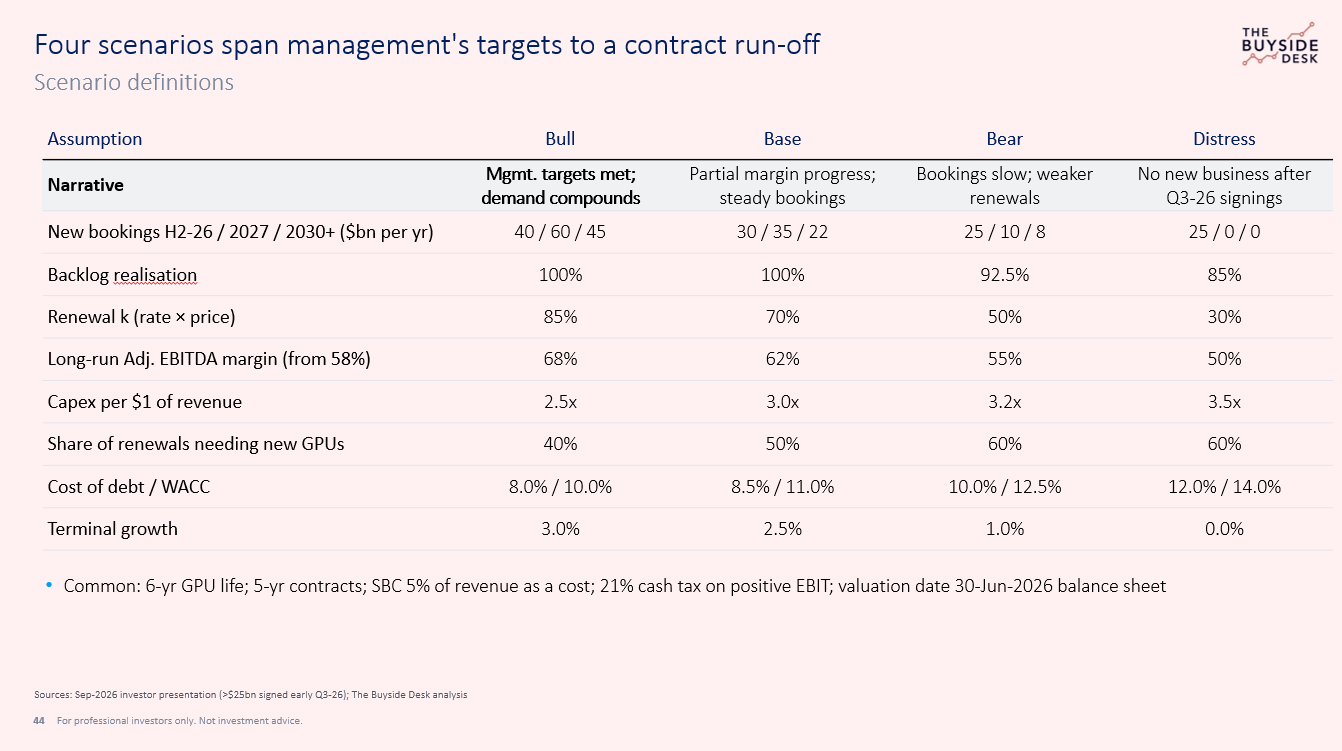
The Bull case is management’s own long-term ambition: a 25–30% adjusted operating margin, which in our model means about a 68% EBITDA margin with capex intensity falling to 2.5x. The Base case gives management partial credit. All four cases use a six-year GPU life, five-year contracts and the June 2026 balance sheet.
Management can not grow their way out of this mess
Part 3 showed that today’s contracts can’t carry today’s obligations. The natural objection is that CoreWeave will keep growing. But growth only helps if each new contract earns more than the money funding it. At today’s economics, it doesn’t.
The table shows the steady-state after-tax return on capital (ROIC) of a GPU cloud for different combinations of EBITDA margin and capex intensity, against our base-case WACC of 11%. At today’s 59% margin and about 3.0x capex intensity, a new contract earns about 2%. Even a 68% margin earns only about 7% at 3.0x. Returns clear 11% only if capex intensity falls to 2.0–2.5x (at 2.5x, only with a margin of 65% or more). At 3.0x, no margin in the table gets there; even 75% earns 10.5%.
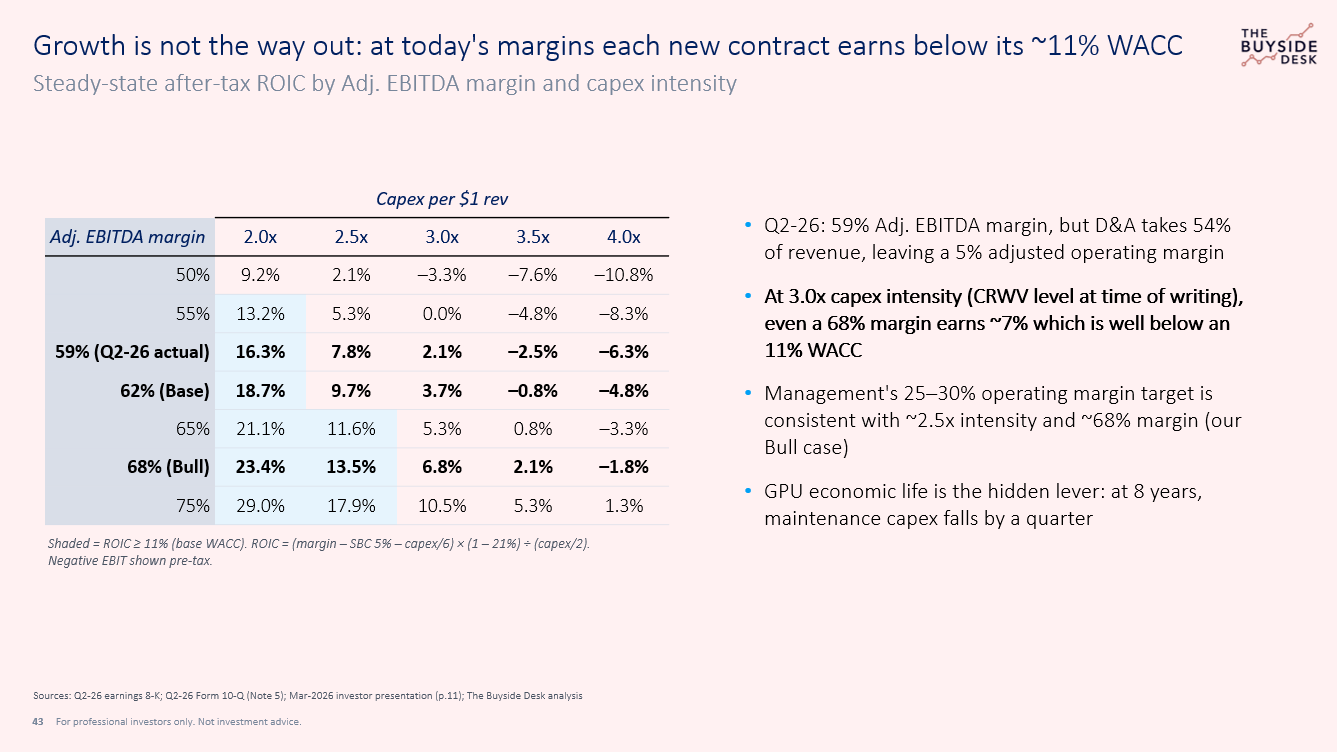
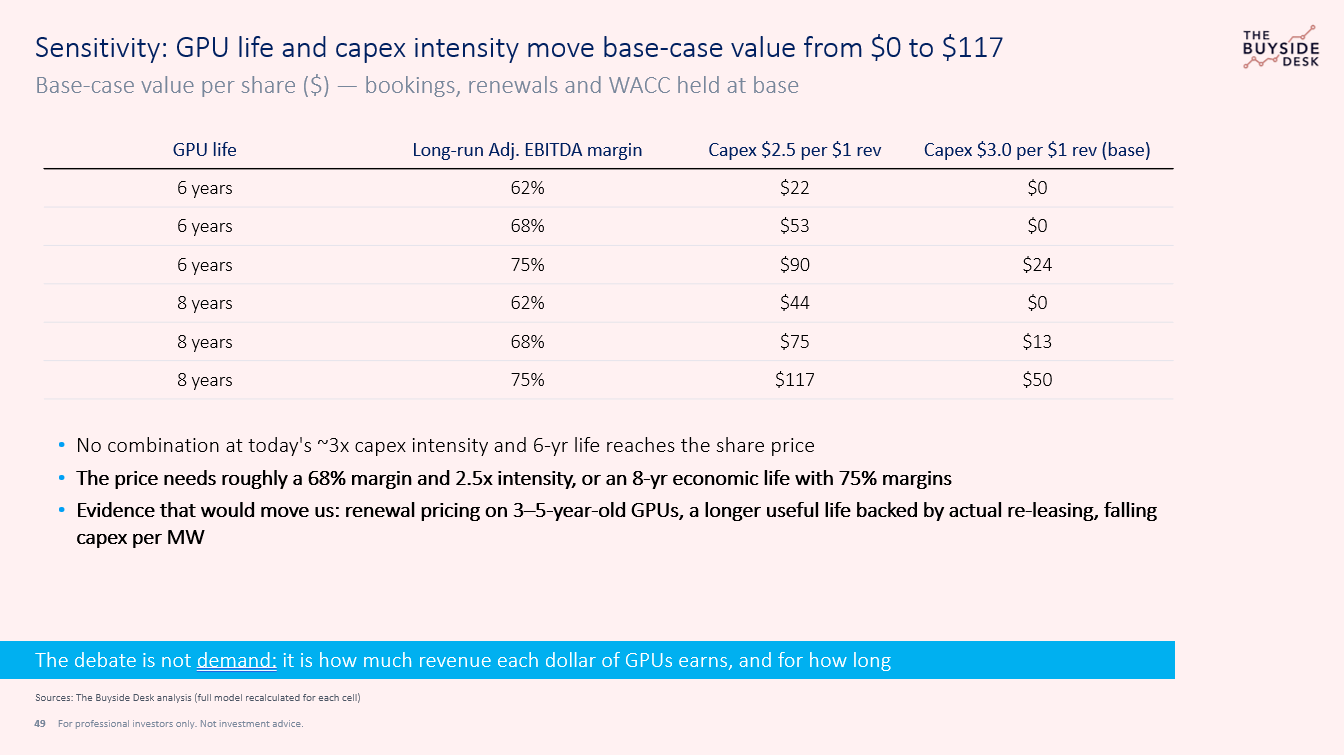
The hidden lever is GPU life. If GPUs stay economic for eight years rather than six, maintenance capex falls by about a quarter. That is why the sensitivity below moves so much with it.
Revenue paths diverge once the backlog is delivered
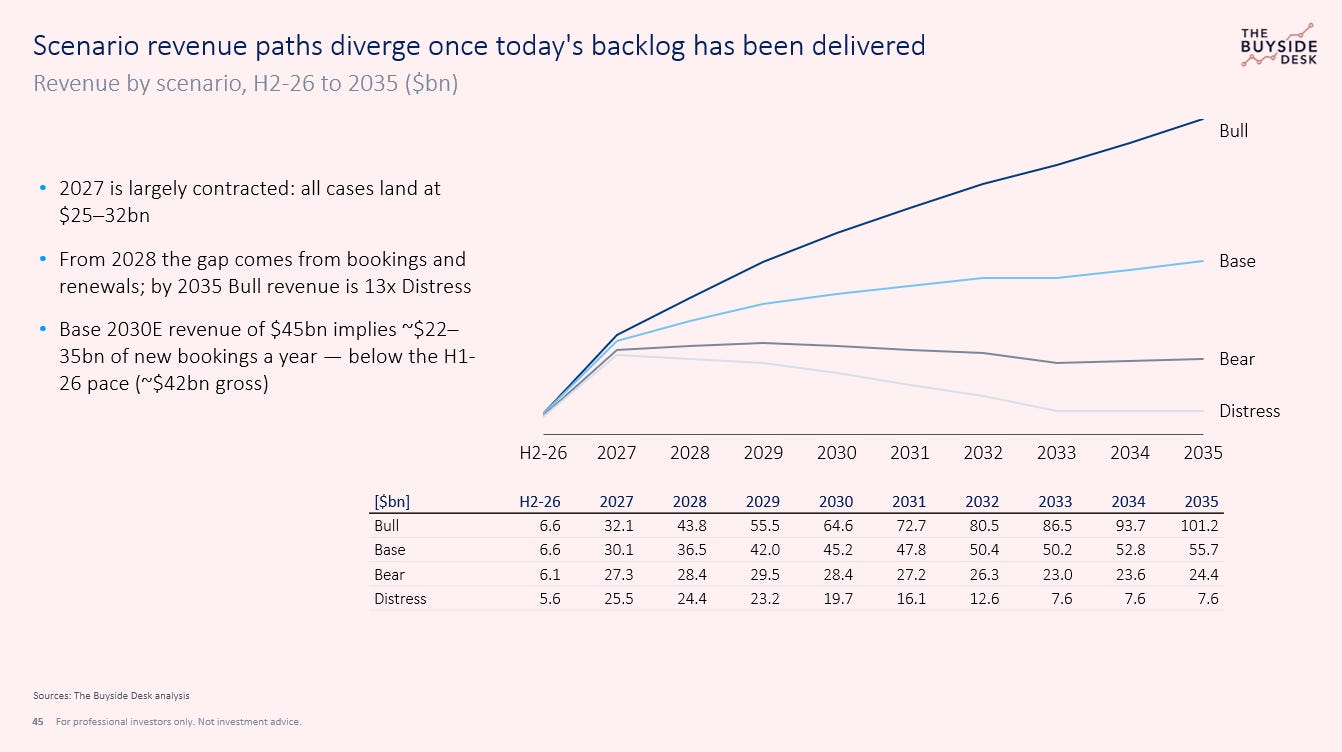
2027 is largely contracted, so every case lands at $25–32bn. From 2028, the difference comes from new bookings and renewals; by 2035, Bull revenue is 13x Distress. Even the Base case is not conservative on growth. Its 2030 revenue of $45bn implies roughly $22–35bn of new bookings a year.
Only the Bull case pays down debt
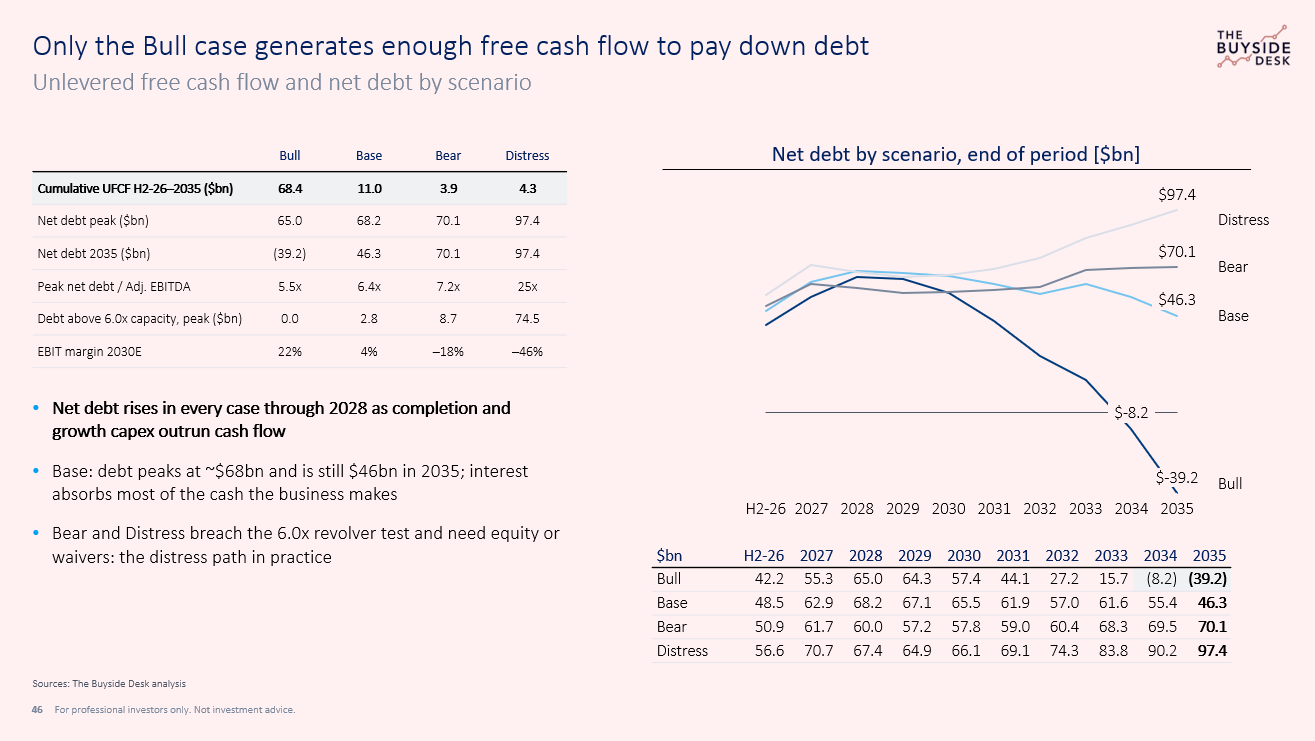
Net debt rises in every case through 2028, as completion and growth capex outrun cash flow. In the Base case, it peaks at about $68bn and is still $46bn in 2035; interest absorbs most of the cash the business makes. Bear and Distress breach the revolver’s 6.0x leverage test and would need new equity or waivers, which in practice is the distress path. Only the Bull case ends with net cash.
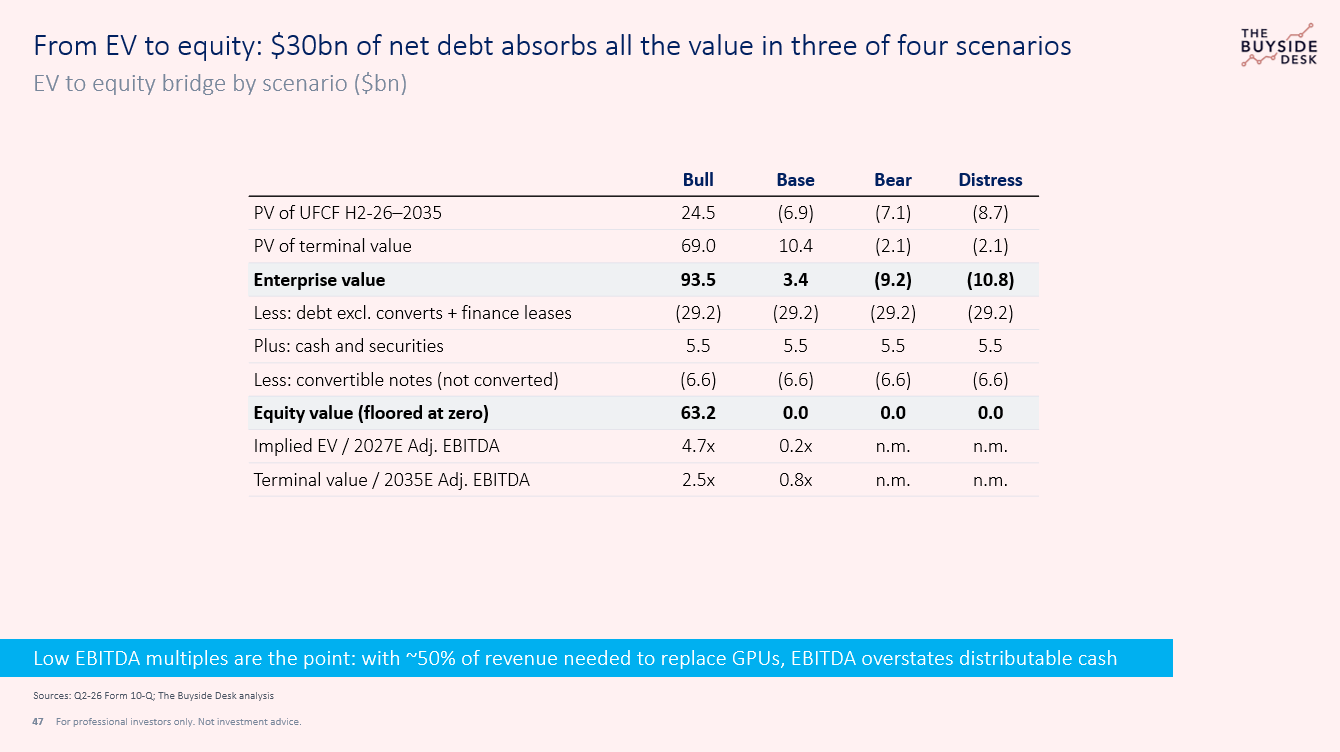
About $30bn of net debt absorbs all the value in three of the four scenarios. The multiples look strangely low, and that is the point. When about half of revenue has to be reinvested to replace GPUs, EBITDA overstates the cash a shareholder can ever receive.
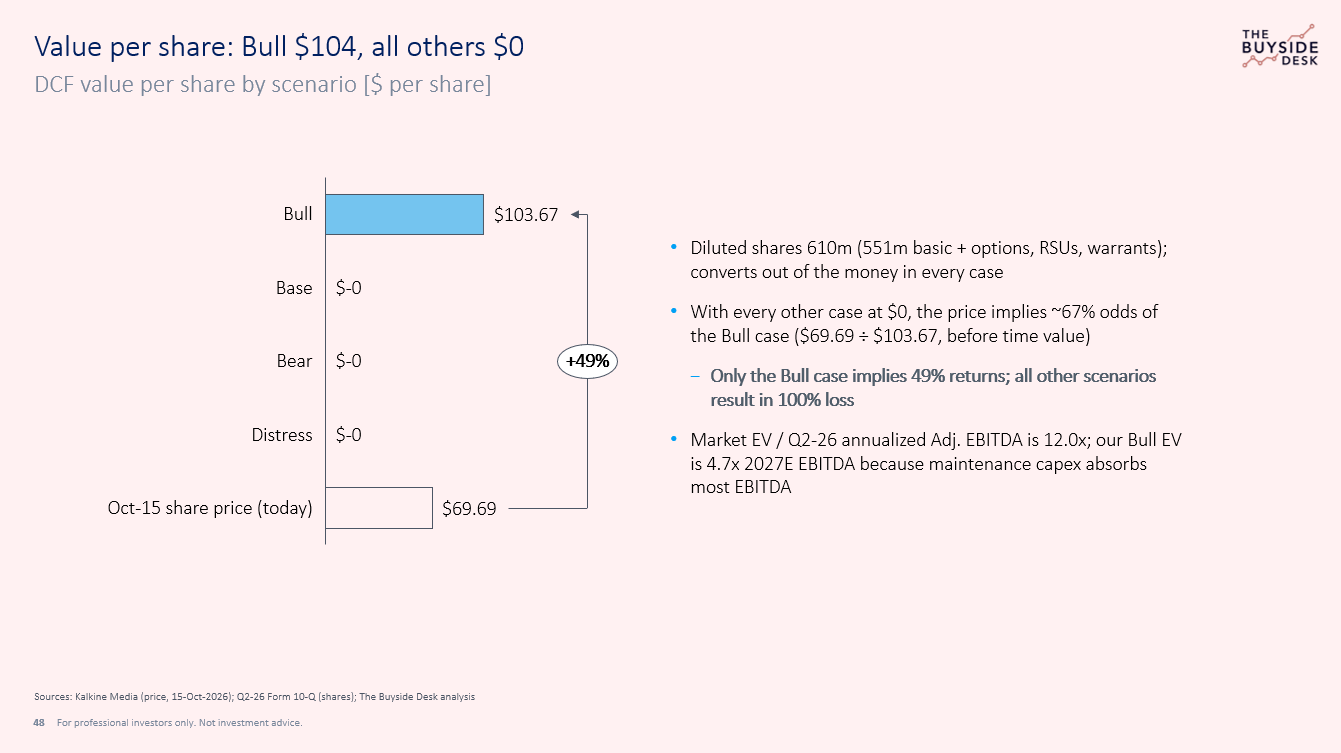
Bull $104, everything else $0
We use 610m diluted shares; the convertibles are out of the money in every case. Because every case except Bull is worth $0, the price itself tells you the market’s implied odds. $69.69 divided by $103.67 is about 67%, before time value. Buying the stock at $69.69 is a bet that management’s targets are more likely than not to be met.
Multiples tell the same story. The market values CoreWeave at 12.0x Q2-26 annualised adjusted EBITDA. Our Bull case, the most optimistic one, is worth only 4.7x 2027E EBITDA, because maintenance capex absorbs most of it.
What would change our mind
The base case is most sensitive to two things: how long GPUs stay economic, and how much capex each dollar of revenue needs. No combination at today’s ~3x capex intensity and six-year life reaches the share price. Getting there needs roughly a 68% margin with 2.5x intensity, or an eight-year economic life with 75% margins.
Those outcomes are possible, and we want to be clear about what would move us: renewal pricing on three-to-five-year-old GPUs, a longer useful life backed by actual re-leasing, and falling capex per megawatt. The debate is not about demand. It is about how much revenue each dollar of GPUs earns, and for how long.
Our rating: SELL, target price $0
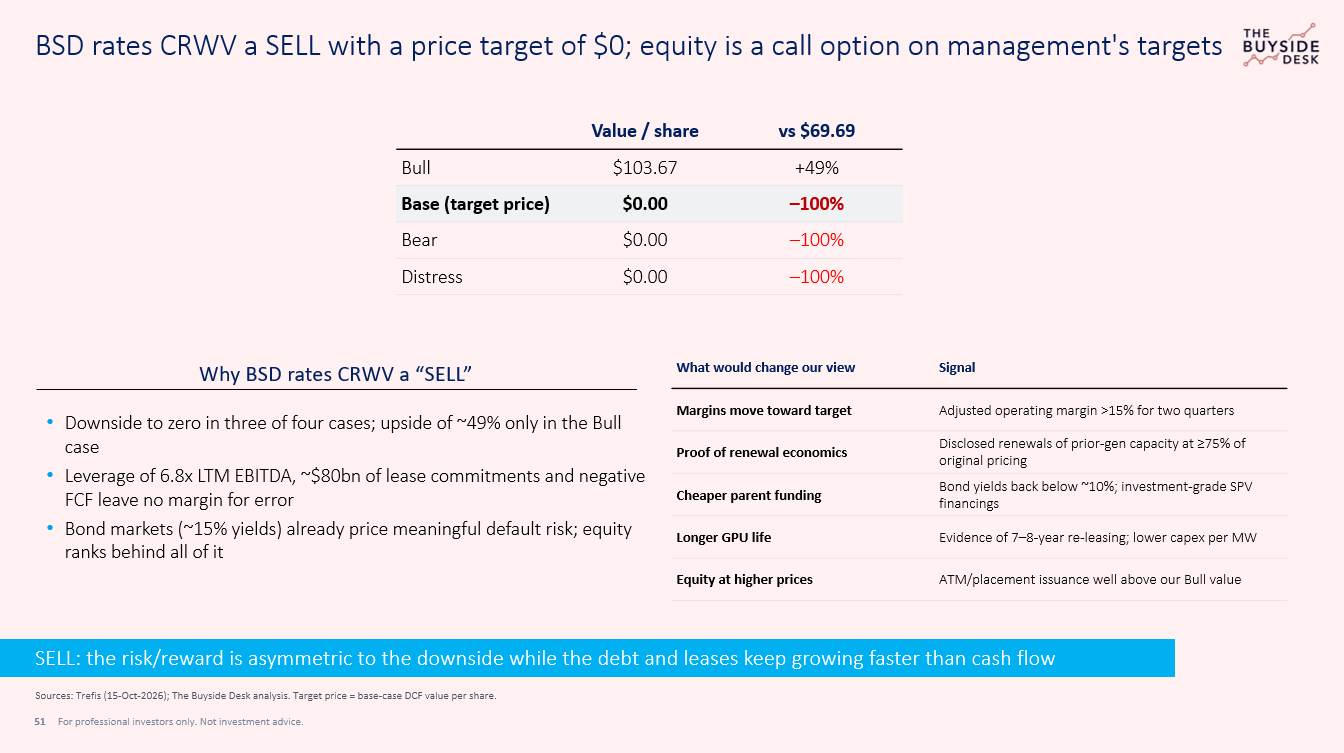
Why SELL: Downside to zero in three of four cases; upside of ~49% only in the Bull case. Leverage of 6.8x LTM EBITDA, about $80bn of lease commitments and negative free cash flow leave no margin for error. Bond markets (~15% yields) already price meaningful default risk, and equity ranks behind all of it.
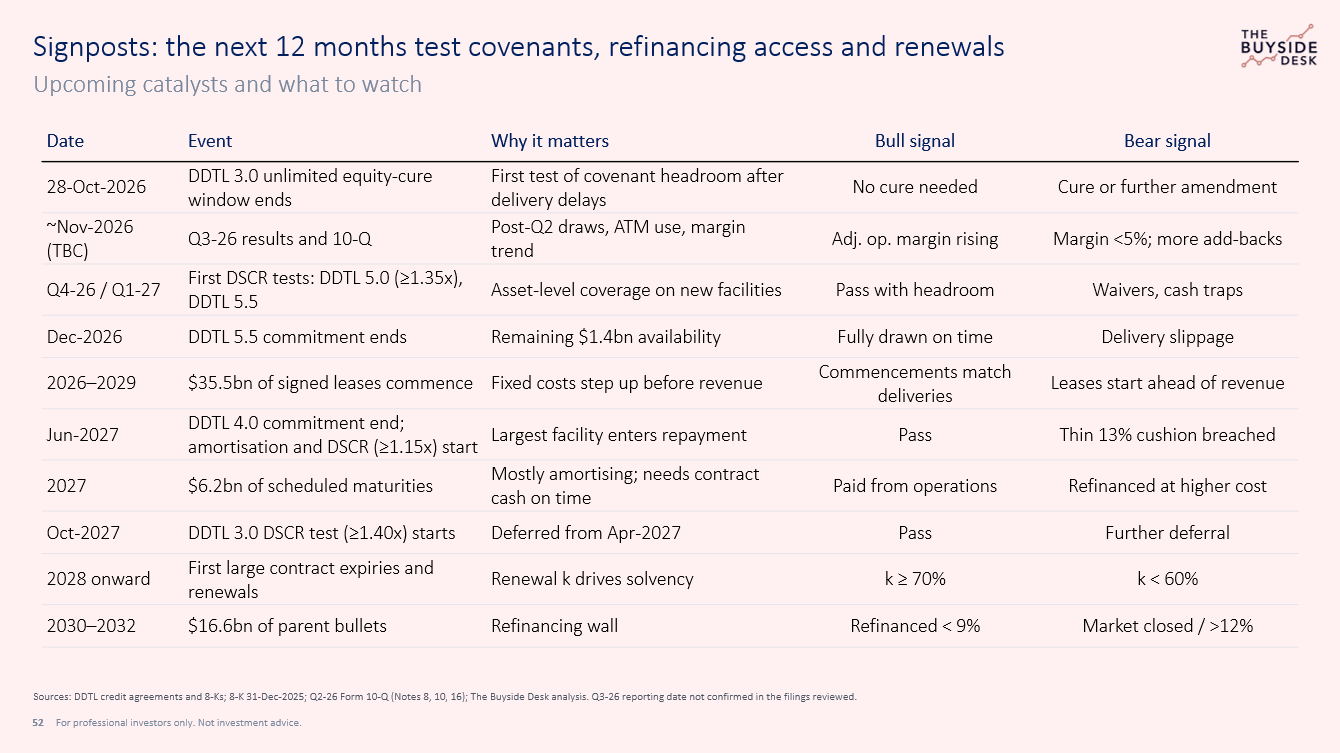
The next signals will come soon:
In summary
CoreWeave has built one of the fastest-growing businesses in AI, and nothing in this series disputes the demand. The question is who gets the value. At today’s economics, each new contract earns less than the money that funds it. Today’s backlog can’t carry the debt and leases on its own. And $51.9bn of claims rank ahead of shareholders, held by creditors who already price CoreWeave close to CCC.
Management’s targets would change that, and our Bull case shows the stock is worth $104 if they are met. But at $69.69, investors are paying for roughly two-in-three odds of that outcome. In the other three scenarios, lenders and landlords absorb the value and the equity is worth nothing.
Our view: SELL, target price $0. We will revisit it when CoreWeave reports Q3-26, and as the first renewals of today’s contracts show what aging GPUs actually earn.