

If I had to choose the hardest and most complicated project I have ever worked on it would be the implementation of a carve-out. The business being carved out (for eventual divestiture) was a global business within a larger conglomerate structure. I was tasked with leading / coordinating the full end-to-end project, from defining the initial concept through to execution of all separation plans. This gave me a front row seat to all the things that went according to plan, the things that did not go according to plan and most importantly: the things we failed to plan for in the first place.
This section of DealFlow is dedicated to the topic of carve-outs and how to execute them. I won’t cover an entire carve-out in one article. Rather I will do small articles covering specific topics. Individually they will seem “incomplete”, but together I hope they emerge as a valuable resource to those tasked with executing the most complicated project a business can do.
The most important message I can give for those tasked with executing a carve-out, or businesses contemplating a carve-out is this: Carve-outs are hard, and you need an advisor that has done it before. The vast majority of companies have no internal expertise with this kind of project. This is not their fault, carve-outs are highly specialized activities and businesses don’t do them very often.
I am available for interim carve-out advisory engagements. If interested, please contact me at stephen.mcnamara@onetoonecf.com for an introductory discussion.
Question 1: At what level will the carve-out occur?
The very first step in defining the carve-out concept is to define the status quo and carve-out objectives. While this seems obvious, it can actually be harder than it seems. Sometimes the Executive Board has not fully aligned on what is to be carved-out. In many cases, the parent company has been built up over so many “bolt-on” acquisitions that nobody actually knows what the company’s legal entity structure even looks like. Key questions include: what specifically do we want to carve-out?
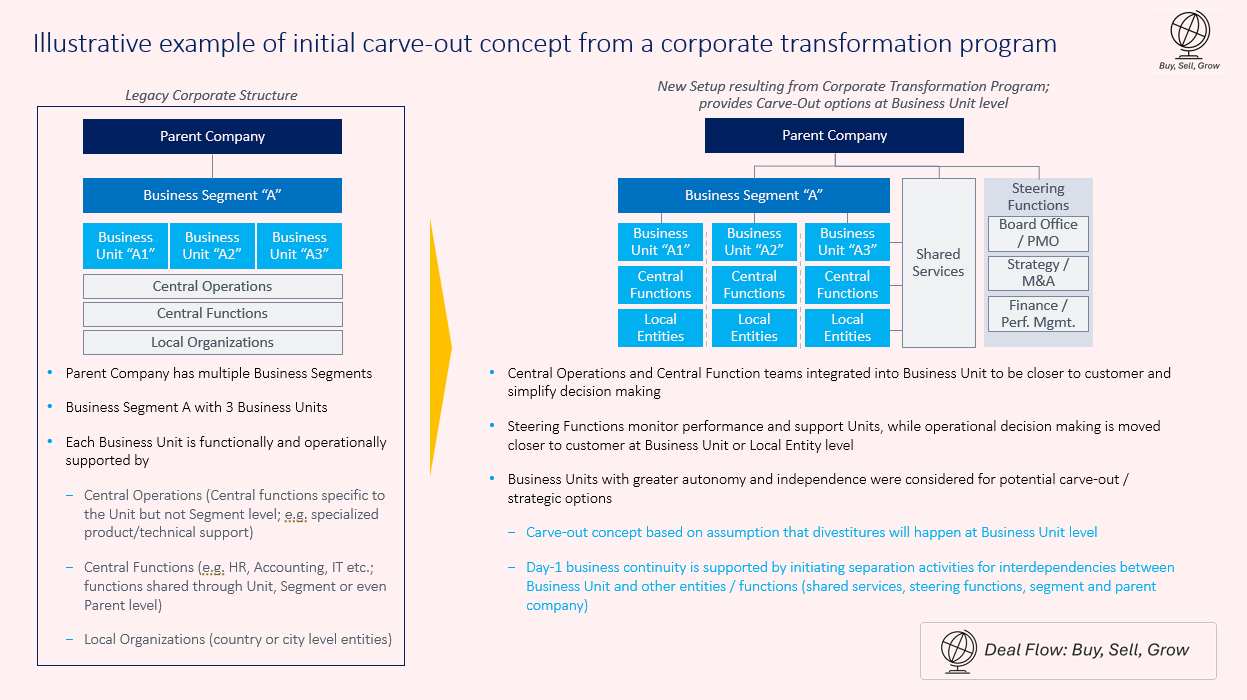
Here is an illustrative example based on my own experience. Imagine a conglomerate with multiple Business Segments organized at industry level. Within each Segment are several Business Units, either based on a Product Category or Region. Within each Unit are Local Operating Entities. The Executive Board decided to try divesting individual Business Units. That meant the a corporate transformation program designed to make each Business Unit as “independent” as possible. This was the starting point for the carve-out concept as it defined the level at which the carve-out would occur.
Question 2: What is the main objective of the carve-out?
This question is simple to answer at a high level. The main objective of a carve-out is to ensure the business being separated can operate independently on “Day-1” and be seamlessly transferred to new owners. Even if the objective does not involve divesting the business, having the option of “easily” doing so is a clear benefit of carve-outs.
Question 3: What are the major interdependencies that need to be dealt with?
This section is “high level”. I’ll do individual deep dives in later posts for each of the major interdependencies listed.
Once the decision has been taken to carve-out a specific business, the question becomes “where to begin?”. The very first thing management teams should do (aside from get experienced advisors in place) is to assess major interdependencies. Specialized teams of advisors will be formed around these categories as they will require significant time and expertise. In general, there are 6 major categories (others will emerge in the project, but these are “the big six”).
Shared Processes: shared services and process interdependencies bewteen corporate entities. Once identified, assign what should happen to each (e.g. get absorbed by buyer, discontinued, Transitional Service Agreement (TSA) etc.)
Shared People: related to the first category, headcounts / FTE’s are often shared across legal entities. They need to be identified in order to give management an idea of how many people may need “special attention” (e.g. workers’ council alignments, union considerations, employee choice about whether they want to stay with the parent vs. carved-out business etc.)
Sites and Locations: Large businesses have offices and facilities around the world. They all need to be listed with clear assignments. Those that are dedicated to the unit to be carved-out are easy. In cases where facilities are shared between entities to be separated, individual plans need to be developed. These often have to consider local requirements (e.g. permitting, licenses, registrations etc.)
Intangible Assets: Depending on the business, patents and trademarks may be shared across entities being separated. These can often drive significant value for both. Careful attention to how these will be allocated during the carve-out is needed
Contracts: Businesses often have hundreds of thousands of contracts. A dedicated team will have to review each one and look for things like “change of control clauses”, customer notification requirements etc. Customers will also have questions about how their contract is impacted the moment a carve-out is announced. The contracts team will need to work closely with the communications team.
Systems: Shared IT systems and corporate applications are usually more numerous than you think. Moreover, they take specialized know-how to deal with during a carve-out. Systems needs a specialized team and is often the biggest and most complex part of the carve-out. For example, imagine you are splitting 40+ legal entities (not uncommon for big companies doing carve-outs). That is 40+ new payroll systems that will have to be established, in flawless coordination with multiple departments to ensure there is no payroll disruptions.
Carve-outs are hard, and you need an advisor that has done it before. If you are considering a carve-out and looking for a potential advisor then please contact me. I am available for interim carve-out engagements.
My email: stephen.mcnamara@onetoonecf.com