


The time frame required to sell a business depends on the complexity of the operation, and in turn the size and circumstances of the company to be sold. Generally speaking, the sale of a company takes 9 to 12 months, but can take longer (18+ months) for more complicated situations. For instance, I was involved in the carve-out of a global industrials business from its parent conglomerate. The company being carved-out was heavily integrated in many of its global locations to other parts of the conglomerate, and getting it fully carve-out was a two year process.
In any company acquisition or sale transaction, time is money. Maximizing the value of your company during the sale will, in no small way, be determined by knowing where your time and money is in the selling process.
Why does it take so long to sell a company?
There are several reasons that justify the investment of time in this operation. If you want to realize a sale with all the value obtained in a long life of wealth creation, the first and best strategic decision is to invest in hiring specialized advisors.
Selling a business is a complex process. For the seller, it can be the most crucial decision of their life. Considering that it is a process that they will go through only once in their life (in most cases), it is normal that the preparation for this decision brings time for reflection and analysis. The seller can make errors of judgment forced by emergencies, such as health problems. Even in that case, having a trusted advisor allows you to face your personal reality with the peace of mind of knowing that your company’s sale is in good hands, without having to accept the first offer presented to you. A good advisor can also help you identify the best time to sell your company.
If the company also has several shareholders, imagine the time it takes to reach an agreement between all of them about the sale’s objectives.
The buyer needs to check and ensure that the value of his purchase is real. When it comes to investing money, rushing is not best practice and preparing the necessary documentation that reflects the real value of a company requires time and professionalism.
Finally, from the point of view of the process itself, all this time is required to maximize the company’s value and carry out the unavoidable phases of a sale and purchase transaction, with all the necessary documentation and negotiations
Doing all this while ensuring that the company does not lose value during the sale process is not an easy task.
And here another question comes as a surprise: can my company lose value during all that time? The answer is, sadly, yes. The sale is a very long process, and if the seller dedicates themself exclusively to this process, they may lose contact with the company. That makes its results decrease and, therefore, its value. As an entrepreneur, the time you dedicate exclusively to the sale of the company will reduce its value and the possibility of profiting from the sale.
The best way to spend your time as an entrepreneur during the sale of your company is to dedicate yourself to it until the process is complete. It is your best contribution to the process, leaving the fieldwork to professional advisers and supervising them.
Time frames for the Phases of the Sale
Phase 1: Analysis of the company and the operation
In this first phase, you have to reach an agreement with shareholders and prepare the company for a sale. Two documents are prepared: the blind profile and the company’s sales notebook. The information memorandum must reflect the reality of the company and its most positive aspects, so that potential investors have the necessary information to assess the purchase. Once the analyst team has all the information about the company, they can prepare the sales notebook in 1 month.
Phase 2: Preparation of the Valuation Report and search for candidates
The Valuation Report helps the seller know their company’s value and can take 1 month to prepare. Regarding the search and screening of candidates, it is one of the most difficult phases and requires a greater investment of time. Being able to filter up to 700 applications, this phase can last up to 1 month.
“Having to analyze and filter more than 700 companies, the candidate selection phase can take up to 400 hours”
Phase 3: Investor Search and Project Presentation
This phase is time-consuming in assessing the interest of all potential buyers. For each selected application, you must find the appropriate contact, send each of them the teaser of the operation, as well as a confidentiality agreement (NDA). The objective is that each one returns the signed NDA, so that the company’s Information Memorandum can be sent to them.
Considering that you have to negotiate with many people simultaneously, and with each one in different phases, this phase can easily take 2 months.
Phase 4: Negotiation of the sale between Buyers and Sellers
In this phase, the seller and buyer finally come into contact, the necessary documentation is sent, and a period of resolution of doubts (of all kinds) is started. Until a Binding Offer materializes, a resolution usually requires many conversations: the buyer requests exhaustive information and consults with his own team and with the seller; you need full confidence in your investment. This period can last an estimated time of 2 months, depending on the agility of both parties’ responses: Seller and Buyer.
Phase 5: Due Diligence
Due Diligence is a process of profound and professional analysis that the buyer commissions about the company for sale. The buyer wants to make sure of the value of what they are buying and contacts auditing companies and tax specialists to prepare a document that can cost between € 40,000 and € 100,000. All this searching, analysis and coordination of information delivery between the two parties can take up to 3 months
Phase 6: Closing
After the agreement, the closing requires the preparation of a Sales & Purchase Agreement (SPA), which a specialized commercial lawyer must prepare. The preparation and negotiation of this contract and the parallel documentation (such as shareholder agreements) can take between 1 and 2 months
Is it possible to make the time frames profitable and even shorten them?
Now that you have an idea of the process and its timeframes, you will ask yourself one last question: is it possible to shorten the timescale ofthe sale ofthe company? Yes, it is possible.
The key to shortening this time as much as possible is planning, with professionals who know how to provide the appropriate documentation and who have experience in negotiation. By presenting the information in an agile and clear way, fewer buyer doubts will arise, and the timeframe of sale is shortened. Additionally, advisors understand decision times and know the times of the year when activity slows down. Knowing this, they avoid unnecessarily lengthening the buying and selling process.
In the same way that you would not build a house without an architect, the recommendation is that you do not sell your business without an advisor’s help.
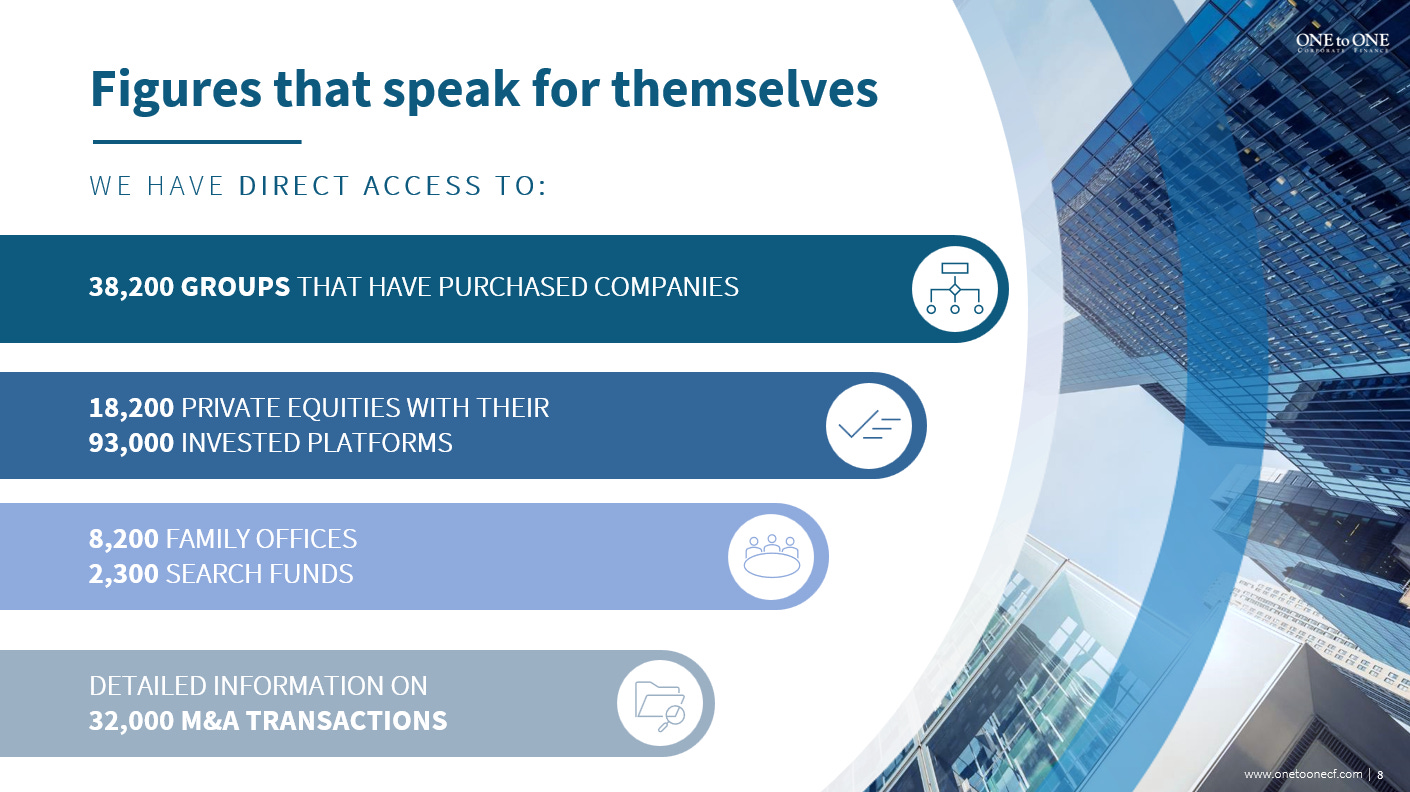
ONEtoONE Corporate Finance is a global investment banking group with 200+ M&A Advisory specialists in over 30 countries and 50+ cities worldwide. They have advised on over 2000 successful M&A transactions, with >70% being cross-border deals.

Contact:
Stephen McNamara has over 15 years experience in Corporate Strategy, M&A, and Investing. He is currently a Senior M&A Advisor with ONEtoONE Corporate Finance. If you are interested in buying or selling a business or investing, please feel free to email: stephen.mcnamara@onetoonecf.com. All correspondence will be handled with utmost confidentiality.