


These are undoubtedly the most frequently asked questions in our meetings with clients: How much does it cost to sell my company? How much does an advisor receive from the purchase/sale of my company? The answer is a classic and can be summarized in two words: it depends.
The first thing to understand is that many professionals will be needed to properly sell a company. Financial Advisors (M&A Advisors), Lawyers, Tax Advisors (not the same as financial advisors), Notaries are all crucial figures - and they all charge for their services. When you decide to sell your company professionally, you will have to ask them about their fees individually.
Your first contact will be the Financial or M&A Advisor who will accompany you through the entire process of selling your company. In general, they charge two types of fees: Fixed Fees and Success Fees.
Fixed Fees or Retainers
Fixed fees or retainers are charged regardless of the outcome of the process. They are commonly associated with documentation delivery or with the achievement of specific landmarks during the sale process. It is not uncommon for the advisor to offer to deduct these fixed fees from the success fees. The truth is that they usually only represent a tiny part of the total costs in the event of deal closure. However, they are still a cost that the business owner must “advance”.
The controversy around fixed fees is their relevance, that is, should I pay them or not? This doubt arises because some advisors work only on a success-fee basis. There is a proverb that says: “What does not cost is not valued” or “You get what you pay for”.
When a business owner starts the process without spending a penny, they have not embraced the sale of the company and they will always be tempted to pull out at any time. Also, a business owner who does not trust their advisor will think that if they have not made the right choice of advisor, at least they have not spent any money. Perhaps the business owner has repeatedly heard cases of friends, saying “They charged me and did nothing”, or perhaps they have already experienced it themselves. While we cannot guarantee that this will not happen, most of the time this lack of professionalism occurs when the transaction has been put into the hands of people who do not work exclusively in this profession. Some excellent professionals will dedicate many hours to the sale of your company. Ask your lawyer, your tax advisor, a competitor who has already sold, or search on the internet for reference. Even if you believe that you have found an advisor in your first meeting, try to obtain a few different proposals and compare them. Remember that you are only going to sell your company once.
Let us go back to the option of not paying fixed fees, but now lets look from the advisor’s perspective. Not having an initial fee in the process swill also affect the advisor and could generate a conflict of interest in the long run, as they may want to close a deal at any cost and without considering whether the chosen buyer is the best option for their client. This would, in part, be due to the advisor’s fear of not closing the transaction and thus not obtaining any fee (if everything is dependent on success), despite having given away time and work.
But what is fair? This is a question that has no easy answer, especially for very different firms (e.g. one with $5 million in revenues vs. $500 million). Every company has different peculiarities and complexities. But what we can say is that at ONEtoONE, each project, no matter how small will have at least two people working on it and could have up to ten. Think about the cost of a senior employee in your company and the hours that they will dedicate each month to a project, and you will have a very rough idea of the price range for fixed fees.
Success Fees
These fees are understood and accepted by all clients. Their name says it all; they are obtained upon the completion of a project, whether that is selling or buying a company that you have been looking for.
However, they can also be complex to calculate. In the sale of a company, the norm is to pay a percentage of the company’s agreed value, since the higher the price achieved, the greater the reward for both the client and the advisor. And what is the percentage rate applied? Again, this is difficult to answer, but there is at least a commonly accepted rule: the rate will be inversely proportional to the transaction size; that is, higher percentages will be incurred in smaller transactions, and lower rates will be incurred in larger transactions.
Do not get carried away by what a friend who has read in a newspaper about a large transaction tells you. Again, different companies have different circumstances. The purchase/sale of a family company is not governed by the figures of Nasdaq-listed companies. The risk of selling, or rather not selling, a small or medium-sized family business is much greater than in large multinationals. For greater risk, there is a higher cost. The range of rates is very wide for family companies and usually goes from 1% for large transactions to 6% for small transactions, based on the transaction value.
Make sure you demand that the rate applied to your transaction is justified. To avoid surprises, grab a calculator and with an estimated value of your company, do the calculations to avoid scares or misunderstandings in the future.
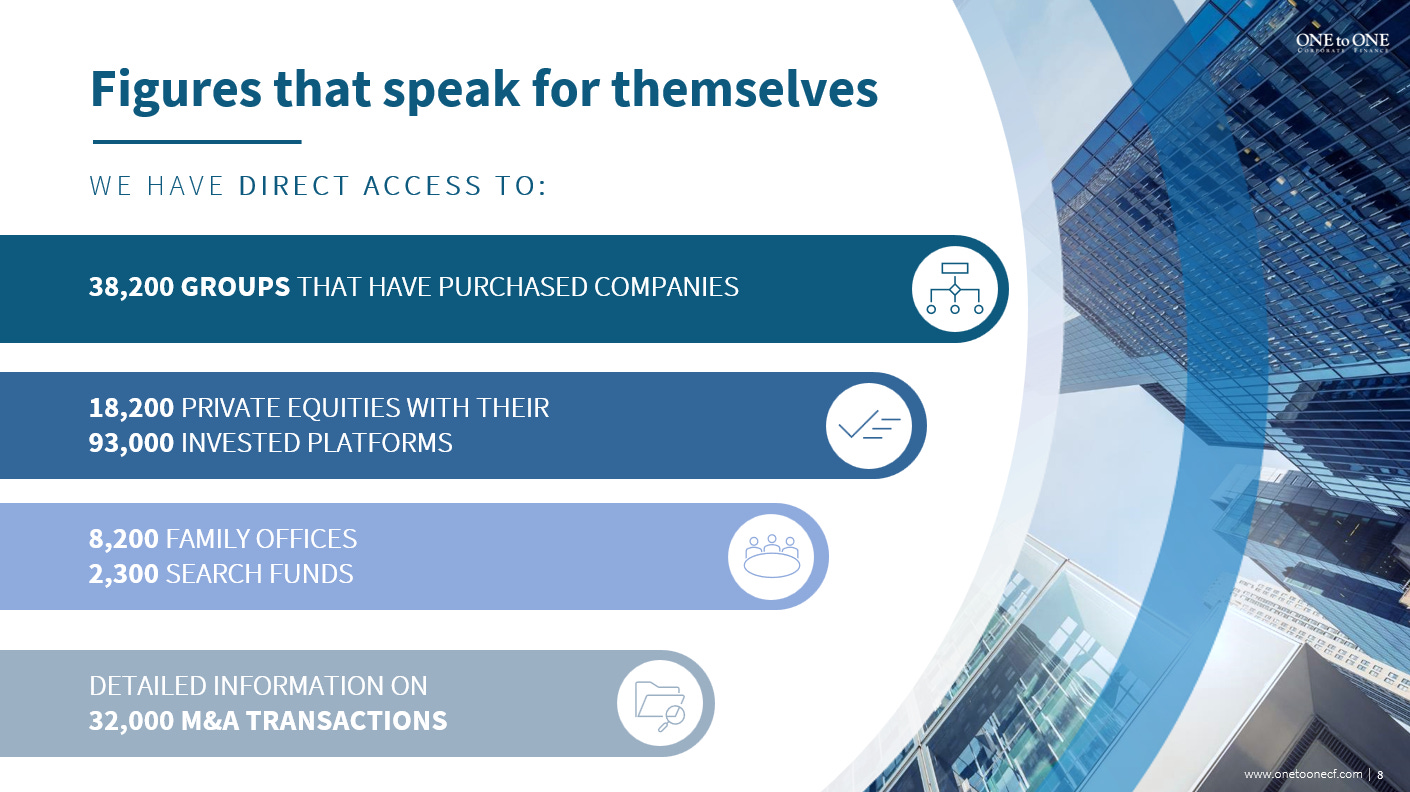
ONEtoONE Corporate Finance is a global investment banking group with 200+ M&A Advisory specialists in over 30 countries and 50+ cities worldwide. They have advised on over 2000 successful M&A transactions, with >70% being cross-border deals.

Contact:
Stephen McNamara has over 15 years experience in Corporate Strategy, M&A, and Investing. He is currently a Senior M&A Advisor with ONEtoONE Corporate Finance. If you are interested in buying or selling a business or investing, please feel free to email: stephen.mcnamara@onetoonecf.com. All correspondence will be handled with utmost confidentiality.